










.svg)
.svg)

.svg)

.svg)
.png?width=512&height=512&name=guru%20(1).png)
.svg)

.png?width=199&height=109&name=salesforce-logo1-removebg-preview%20(1).png)



.svg)

.svg)
.svg)

.webp?width=716&height=569&name=banner-img%20(1).webp)


"AI SMS chatbot" is one of those terms that sounds self-explanatory until you try to buy one. Ask three vendors what it means and you'll get three different products, ranging from a keyword menu that sends auto-replies to a full conversational system that qualifies leads, books calls, and hands off to a human agent when the timing is right.
The gap between those two things is enormous, and it determines whether your customers feel helped or annoyed.
This guide explains what AI SMS chatbots actually are, how the technology works, and where each type fits, so you can evaluate what you're actually looking at before you commit.
What is an AI SMS chatbot?
An AI SMS chatbot is software that sends and receives text messages on behalf of a business and generates responses using artificial intelligence rather than fixed scripts. Instead of matching an incoming message to a predetermined keyword and returning a canned reply, an AI-based system interprets what the person actually means and responds accordingly.
The definition covers a wide spectrum of sophistication. At one end: simple bots that match a handful of keywords and route people to a menu. At the other: conversational systems that hold a genuine back-and-forth, understand context across multiple messages, qualify a lead against specific criteria, and transfer the conversation to a human at exactly the right moment.
Most of the confusion in this category comes from treating those two things as the same product.
Rule-based bots vs. conversational AI chatbots
Rule-based bots operate on keywords and conditional logic. A contact texts "HELP," they get a support menu. They text "HOURS," they get your business hours. The bot has no understanding of language. It pattern-matches. If the contact types something it doesn't recognize, it either loops back to the menu or fails silently.
This works fine for narrow, transactional interactions: opt-in confirmations, one-touch FAQs, simple reminders. It breaks down fast when customers send anything open-ended.
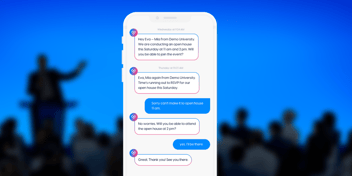
Conversational AI chatbots use natural language processing (NLP) and large language models (LLMs) to interpret intent, not just keywords. "Can someone reach out to me this week?" and "I'd like to schedule a call" are phrased completely differently, but a conversational AI system understands that both represent the same request. It can ask a follow-up question, check availability, and move the conversation forward without human intervention.
The practical difference: a rule-based bot handles a script. A conversational AI handles a real exchange. See this in-depth comparison between conversational AI vs. chatbots for more details.
AI SMS chatbot vs. SMS automation
These two terms get conflated, but they describe different things.
SMS automation is trigger-based. An event happens (a form is submitted, a payment is due, an appointment is approaching), and a message goes out. One direction. No reply expected. Appointment reminders, shipping notifications, and one-time passcodes are all SMS automation.
An AI SMS chatbot is two-way. It's designed to receive replies, interpret them, and respond intelligently. The conversation can branch in multiple directions depending on what the contact says. The goal isn't just to send a message; it's to have an exchange that moves someone from interest to action.
Many businesses use both. Automated reminders go out via SMS automation. Follow-up conversations that need to qualify intent or handle questions run through a conversational AI layer.
How does an AI SMS chatbot work?
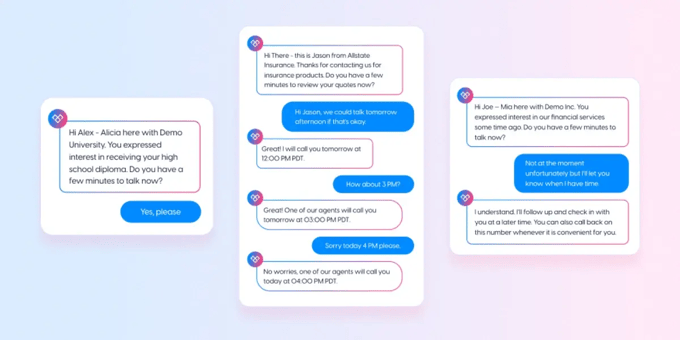
The flow has a few consistent components regardless of which platform you're evaluating.
1. A contact sends or receives an initial message. This could be an inbound text to a shortcode or long code, or an outbound message triggered by an event in your CRM (a new lead opt-in, for example).
2. The NLP/LLM layer interprets intent. The AI parses the message to understand what the person is asking or saying. Modern systems use large language models that handle free-form language, colloquialisms, and incomplete sentences far better than older keyword-matching approaches.
3. The system generates a contextual reply. The response is generated based on the interpreted intent, the conversation history, and any business-specific content or rules the system has been given. A well-configured system answers from approved content, which keeps responses accurate and on-brand.
4. Business logic runs alongside the conversation. Qualification criteria, routing rules, and escalation triggers run in parallel. If a contact meets certain criteria ("expressed interest in enrollment," "confirmed income range," "requested a callback"), the system can take an action: book an appointment, send a handoff alert to a human agent, or initiate a voice call.
5. The conversation is logged and synced. Activity feeds back into your CRM or sales stack so your team has full visibility without needing to check a separate platform.
The moving parts: a phone number or sender ID, the AI engine, a knowledge base or approved content layer, business logic, CRM integration, and compliance controls for outbound consent.
What businesses use AI SMS chatbots for
The use cases below represent where conversational AI over SMS is producing consistent, measurable results.
Lead capture and qualification. When a new lead opts in, an AI SMS chatbot can reach out within seconds, ask qualifying questions, and route high-intent contacts to a human while filtering out unqualified ones. This matters most in industries where speed-to-lead is a direct driver of conversion, including insurance, personal lending, and higher education admissions.
Appointment booking and reminders. The chatbot handles appointment scheduling automatically, confirms the appointment over text, and sends reminders that contacts can respond to. Contacts who need to reschedule can do so without calling, which reduces no-shows without adding work for your team.
Re-engagement of aged leads. Leads that went cold because no one followed up fast enough, or because manual outreach was deprioritized, can be re-engaged through conversational texting.
Penn Foster used this approach to follow up with aged leads that had been inactive for more than seven days, a segment the school had previously stopped pursuing. The result was a 42% increase in lead-to-enrollment rate and $1.2 million in incremental revenue.
Customer support deflection. Repetitive inbound questions ("What are your rates?" "How do I submit a claim?" "When is my appointment?") are well-suited to conversational AI. The chatbot handles the volume; complex or sensitive issues are escalated to a human.
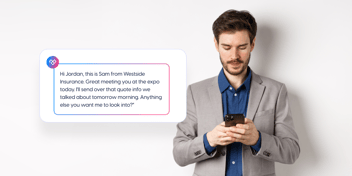
Post-event and post-purchase follow-up. After an event, a purchase, or a service interaction, a text-based follow-up can gather feedback, confirm next steps, or surface upsell opportunities while the interaction is still fresh.
The benefits and the limits of AI SMS chatbots
Benefits
Instant response, around the clock. Text messages arrive immediately, and an AI chatbot can respond within seconds regardless of the time. For businesses where speed-to-lead matters, that response window is often the difference between a qualified conversation and a cold lead.
High open and response rates. SMS consistently outperforms email on reach. Research from Validity finds that around 90% of SMS messages are read within three minutes of delivery. That reach advantage compounds when the message starts a real conversation rather than delivering a one-way blast.
Scale without proportional headcount. A conversational AI system can run hundreds of simultaneous text exchanges. The contacts that are ready to talk get routed to a human; everyone else is engaged, qualified, and nurtured automatically.
Reduced repetitive work for your team. Every FAQ answered by a chatbot and every unqualified contact filtered before reaching a human saves rep time for higher-value conversations. One insurance agency in Meera's customer base described the problem clearly: they were individually responding to every inbound text and couldn't separate serious buyers from wrong numbers at any useful speed. That's a solvable problem.
Limits
A poorly built keyword bot creates friction, not conversion. If someone texts a free-form question and gets a menu they didn't ask for, they disengage. The limit isn't SMS as a channel; it's the quality of the conversational layer. A rule-based bot positioned as "AI" will underperform against a genuine NLP-based system.
The AI needs good inputs. A conversational system is only as reliable as the content and rules it's given. Poorly configured knowledge bases produce off-brand or inaccurate responses. This is one of the strongest arguments for working with a managed platform rather than stitching together an SMS API and a general-purpose LLM yourself.
Outbound SMS requires consent. Any business running outbound text campaigns needs TCPA-compliant opt-in from contacts before messaging them. 10DLC registration is required for most business SMS traffic in the U.S. These aren't optional steps, and they have real consequences if skipped.
What to look for in an AI SMS chatbot
Genuine conversational understanding. The system should handle free-form replies, not just keywords. Ask the vendor to show you how it handles edge cases: a contact who replies with a question instead of an answer, or who changes their mind mid-conversation.
Qualification and routing built in. A chatbot that just responds to messages but can't make decisions is only doing half the job. Look for systems that can qualify contacts against your criteria and transfer the right ones to a human at the right moment.
Answers grounded in approved content. Responses should come from your approved information, not a general-purpose LLM improvising. This protects accuracy, brand voice, and compliance.
CRM and stack integration. The chatbot should work with the systems you already use. Standalone tools that don't feed data back into your CRM create reporting gaps and duplicate workflows. Look for native integrations with platforms like Salesforce, HubSpot, and Five9.
Compliance controls. Opt-in management, opt-out handling, and outbound consent documentation should be built into the platform, not left to you to configure manually.
Build vs. buy
A DIY approach (SMS API plus an LLM plus an automation tool like Zapier or Make) is technically possible and sometimes the right call for teams with strong engineering resources and narrow, well-defined use cases.
The trade-offs are real: you own the compliance burden, the conversation design, the maintenance, and the iteration. Most teams that try to build a production-grade conversational system this way underestimate the ongoing work required to keep responses accurate and the conversation quality high.
A managed conversational AI platform handles the conversation design, compliance infrastructure, and optimization as part of the product. The faster path to production for most business buyers, particularly those without a dedicated AI engineering team, is buying rather than building. Meera's build vs. buy overview covers this trade-off in more detail if you're evaluating both options.
From chatbot to conversational AI: How Meera helps
Most SMS chatbots answer messages. A conversational AI system like Meera holds a real exchange.
The practical distinction: Meera starts with SMS, asks qualifying questions one at a time, answers from your approved content, and moves the conversation toward a defined outcome, typically a booked call or a warm transfer to a human agent.
When a contact is ready to talk, Meera initiates the voice connection directly. The human agent picks up a conversation that's already qualified, not a cold call. That's the DialogueDesign framework: built for outbound qualification, not just inbound deflection.
Level Financing, a personal lending company, used this approach to contact new leads within 15 seconds of opt-in. Of the leads Meera engaged, 43% responded to the initial outreach, 56% went on to qualify, and 97% of those qualified leads booked a call. That pipeline of booked calls was generated without a rep making a single manual outreach attempt.
The architecture runs across SMS and voice, integrates with existing CRM and call-center stacks, and includes built-in compliance controls for TCPA and opt-in management.
FAQ
What is an AI SMS chatbot? An AI SMS chatbot is software that sends and receives text messages on behalf of a business and uses artificial intelligence to interpret and respond to those messages. Unlike rule-based bots that match keywords to canned replies, AI-based systems understand intent, handle free-form language, and can take actions like qualifying a lead or booking an appointment based on what the contact says.
How does an AI SMS chatbot work? An AI SMS chatbot receives an inbound text (or sends an outbound one based on a trigger), passes it through a natural language processing layer to interpret intent, generates a contextual reply using the AI engine and any approved content or business rules, and logs the interaction back to your CRM. In more advanced systems, the chatbot also evaluates whether the contact meets qualification criteria and routes ready-to-convert contacts to a human agent.
What's the difference between an SMS chatbot and SMS automation? SMS automation is one-directional: a trigger fires and a message goes out. Appointment reminders, shipping updates, and payment alerts are SMS automation. An SMS chatbot is two-way: it receives replies, interprets them, and responds accordingly. Many businesses use both, running automated alerts through SMS automation and qualification or nurture conversations through a chatbot.
What's the difference between a rule-based and a conversational AI SMS chatbot? A rule-based bot responds to specific keywords or menu selections. If a contact sends something it doesn't recognize, it fails or loops back. A conversational AI chatbot uses NLP and LLMs to understand intent, not just match keywords. It can handle free-form replies, follow the logic of a real conversation, and respond appropriately even when contacts phrase things in unexpected ways.
Is an AI SMS chatbot compliant with TCPA and 10DLC requirements? It can be, but compliance depends on the platform and how it's configured. TCPA requires prior express written consent before sending marketing or promotional texts. 10DLC registration is required for most business SMS traffic in the U.S. Any platform you evaluate should include opt-in management, opt-out handling, and consent documentation as part of the product, not as an afterthought. This is not legal advice; consult qualified counsel for your specific situation.
The takeaway
If you need triggered, one-way reminders and alerts, that's SMS automation and a lightweight tool will serve you well. If you need two-way conversations that qualify contacts, book calls, and hand off to a human at the right moment, that's a conversational AI system, and it works very differently from a keyword bot.
The distinction matters because the wrong tool, positioned as AI, will frustrate your contacts and produce poor results. The right one can meaningfully change your contact and conversion rates.
If lead qualification and outbound follow-up are the core use case, see how Meera approaches conversational AI for sales teams or book a demo to see it in action.
About the Author