














.svg)
.svg)

.svg)

.svg)
.png?width=512&height=512&name=guru%20(1).png)
.svg)


.png?width=199&height=109&name=salesforce-logo1-removebg-preview%20(1).png)





.svg)

.svg)
.svg)


.webp?width=716&height=569&name=banner-img%20(1).webp)


The 8 Best Strategies For Aged Leads 2026
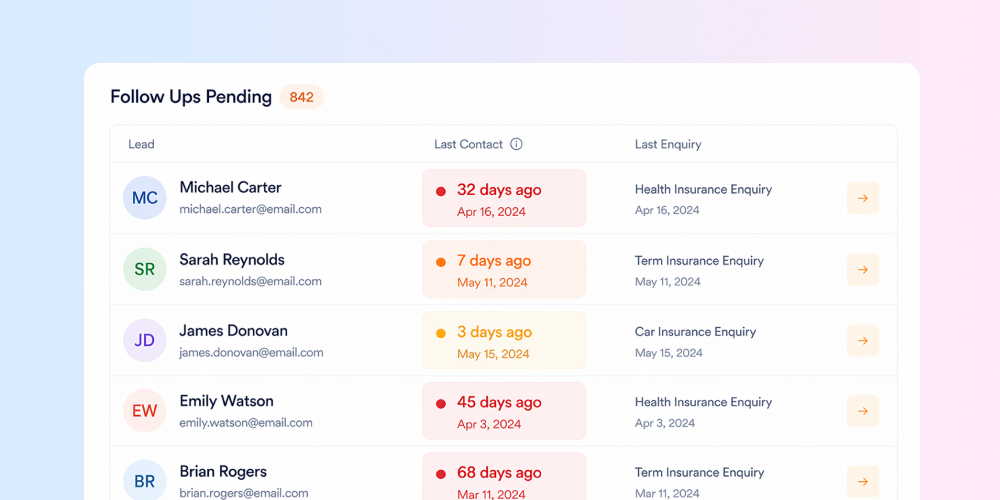
Aged leads are often misunderstood. Many teams treat them as low-quality opportunities simply because they did not convert the first time around. In reality, an aged lead is usually just a prospect whose timing, attention, or follow-up path did not line up when the original inquiry happened. That does not make the lead useless. It means the business needs a better re-engagement strategy.
That is what makes aged leads so valuable. They are often more affordable than fresh leads, and they represent people who have already shown some level of interest. The challenge is not whether they can convert. The challenge is whether your team has the right system to restart the conversation in a way that feels relevant, timely, and easy to act on.
This matters across industries, especially in high-intent categories where speed and follow-up shape outcomes. Insurance is a strong example because prospects often compare multiple options and quickly move on when follow-up is inconsistent. But the same pattern applies in mortgage, home services, higher education, and other service-driven verticals where buyers may need multiple touchpoints before they are ready to move forward.
That is why the best strategy for reengaging old leads is not simply contacting them again. It is combining fast outreach, conversational follow-up, qualification, and a clear next step. At Meera, that is exactly where conversational AI creates an advantage.
Why aged leads still matter
Aged leads are attractive partly because they tend to cost less than fresh leads, but lower cost is only part of the story. They also represent previous buying intent. Someone who requested a quote, asked for information, or showed interest before may still be a fit today, even if the original opportunity went cold.
The problem is that many businesses work aged leads with the wrong playbook. They make a few calls, send a generic email, and assume the list is bad if response rates are low. In most cases, the issue is not the existence of demand. It is the way the outreach is handled.
Aged leads usually need reactivation, not repetition. That means a different message, a different channel strategy, and a better system for moving the lead toward the next step once interest comes back.
1. Open with a re-engagement message, not a fresh-lead script
One of the most common mistakes with aged leads is treating them like they came in five minutes ago. They did not. By the time you reach out, the prospect may barely remember the original inquiry, may have spoken to other providers, or may be in a different stage of decision-making altogether.
That means the first message should acknowledge reality without creating friction. Instead of jumping straight into a sales pitch, start with a short message that makes it easy to respond. A better approach is to re-open the conversation with a simple question, a check-in, or a quick offer of help.
Tactically, this means:
- Keep the first message short
- Avoid overly polished sales language
- Ask one easy-to-answer question
- Focus on current interest, not old activity
The goal is not to close immediately. The goal is to get the lead talking again.
2. Prioritise texting for first reactivation attempts
If your first reactivation attempt depends on a cold phone call, you are making the lead work too hard. Aged leads tend to respond better when the barrier to engagement is low, and texting is one of the easiest ways to do that.
Texting feels lighter than a voicemail and more immediate than email. It gives the prospect room to respond on their own time while still keeping the exchange conversational. That is especially important when you are trying to restart momentum rather than force a decision.
For teams working with older lists at scale, this is where insurance teams can benefit from AI texting. Instead of relying on manual outreach alone, businesses can use texting to re-engage aged leads quickly, identify who is still interested, and keep conversations moving without creating more call volume for agents.
Tactically, this strategy works best when you:
- Send the first text quickly after assigning the lead
- Avoid long paragraphs
- Keep the call to action simple
- Follow up based on the lead’s reply, not just the calendar
3. Build a real follow-up cadence before launching the campaign
Aged leads rarely convert on one touch. If there is no follow-up structure behind the first message, the campaign usually underperforms before it has a real chance to work.
That is why one of the best strategies for aged leads is to map the cadence before you start. Decide in advance how many touches each lead should get, what channels you will use, and how the messaging will change from one step to the next.
A practical cadence might include:
- An initial text
- A second text with a slightly different angle
- A call attempt for engaged leads
- A reminder or check-in a few days later
- A final reactivation attempt before recycling the lead
The point is not to overwhelm the lead. It is to stay visible long enough to catch the right timing. Aged leads often respond on the third or fourth touch, not the first.
4. Qualify current intent early
Once an aged lead responds, the next mistake is assuming they are ready for the same sales path as a fresh lead. Some are ready now. Some are only exploring again. Some want information before speaking to anyone. Others are not a fit anymore.
That is why you should qualify current intent as early as possible. The goal is to understand where the lead stands today, not where they stood when they first opted in.
Tactically, that means using follow-up questions that help you identify:
- Whether the lead is still interested
- Whether timing is immediate or later
- Whether they are comparing options
- Whether they are ready to speak with someone now
This is where conversational AI becomes more useful than a static drip sequence. It can help teams react based on what the lead says, rather than sending the same next message to everyone.
5. Remove friction when a lead is ready to book
Aged leads often re-engage in short windows. They reply, ask a question, or show renewed interest, and then the business loses momentum because the next step is too manual.
If someone is ready to move forward, booking should be easy. That is why reducing friction around scheduling is one of the most practical strategies for aged leads. Instead of creating more back-and-forth, businesses should make it simple for leads to confirm a time while interest is still there.
That is where appointment scheduling fits naturally into the process. It helps teams turn renewed engagement into a booked call or meeting without slowing the conversation down.
Tactically, this strategy works best when:
- The booking option appears early for high-intent leads
- Reminders are automatic
- Rescheduling is easy
- Reps do not need to manually coordinate every time slot
6. Move high-intent aged leads to a human quickly
Not every reactivated lead needs the same path. Some need more nurturing. Others are ready to speak with someone as soon as they reply.
When that happens, speed matters. If a high-intent aged lead has to wait too long for a callback, the opportunity can cool off again. That is why one of the strongest strategies is to connect ready leads to a human team member as quickly as possible.
For businesses that want to shorten that gap, warm call transfer is a natural fit. Instead of letting the conversation stall after re-engagement, teams can move interested prospects to a live agent at the right moment.
Tactically, this is most effective when you:
- Define what counts as high intent
- Trigger transfer based on clear signals
- The route leads only when someone is available
- Avoid making the prospect repeat everything again
7. Segment aged leads before outreach begins
Not all aged leads should be treated the same. A lead from 30 days ago is different from one that is 6 or 12 months old. A lead who responded before is different from one who never engaged. A lead tied to one product or service is different from another.
Segmentation improves performance because it helps you match the outreach to the lead. That means better timing, better messaging, and better prioritisation.
Before launching a campaign, segment aged leads by:
- Lead age
- Source
- Product or service type
- Previous engagement
- Previous outcomes or notes
This gives your team a better chance of sending the right message instead of one broad sequence that fits nobody particularly well.
8. Measure reactivation outcomes, not just reply rates
Reply rates matter, but they do not tell the whole story. A campaign can get responses and still fail to create a real pipeline if those replies do not turn into qualified conversations or booked next steps.
That is why the strongest teams measure reactivation, not just activity. The point of working aged leads is not to create noise. It is to recover opportunities.
Track metrics such as:
- Response rate by lead age
- Qualified conversation rate
- Booking rate
- Live transfer rate
- Conversion rate after re-engagement
- Time from first reply to next step
These measurements help you see which segments, messages, and workflows are actually producing value.
Why Meera is the best strategy for aged leads
Most aged lead campaigns fail for the same reason: they are a one way blast.
The team uploads a list, fires off a "Hey, are you still interested?" text or email, and waits. A handful reply, most ignore it, and the rest of the list goes back into the database to age another six months. The leads were not the problem. The approach was.
Aged leads convert when the outreach feels like a real conversation, not a recycled pitch. That is what Meera does differently:
- Restart the conversation, do not re pitch it. Meera opens with a natural, context aware text that sounds like a human checking in, not a marketing automation reminding the lead they once filled out a form.
- Qualify intent in real time. When someone replies, Meera asks one question at a time and figures out who is actually back in market versus who is just being polite. Reps stop wasting hours on leads that were never going to convert.
- Move warm leads forward immediately. The prospects who are ready get booked or transferred to a live agent on the spot. No "we will follow up shortly." No callback queue.
- Keep nudging the rest. Leads who reply but are not ready yet stay in a conversational follow-up loop. The ones who go quiet get re engaged on a sensible cadence, automatically.
- No extra load on the team. All of this happens without a rep manually working the list. Your team only gets pulled in when there is a real conversation to have.
Most companies are sitting on a database that already cost them money to acquire. The CFO knows the number. The CRO knows the number. What they do not have is a way to actually work that list without hiring more reps or running another campaign that gets ignored. Meera turns that backlog into booked calls without adding headcount or asking your team to do more dialing.
Final thoughts
The best strategies for aged leads are not about squeezing more calls out of an old database. They are about building a better reactivation system.
Start with a message that matches the age of the lead. Use a channel that is easy to answer. Follow up with a real structure. Qualify current intent early. Make scheduling simple. Move ready leads to a human without delay.
That is the difference between touching an aged list and actually turning it into a pipeline. On Meera’s blog, the bigger takeaway is straightforward: aged leads are still valuable when the follow-up experience is fast, conversational, and built around momentum. When businesses can re-engage leads, qualify them in real time, and help them take the next step without friction, aged leads become far more than leftovers. They become recoverable revenue.
About the Author
.webp?width=46&height=46&name=sdfsd%20(1).webp)
Vivek Zaveri