













.svg)
.svg)

.svg)

.svg)
.png?width=512&height=512&name=guru%20(1).png)
.svg)


.png?width=199&height=109&name=salesforce-logo1-removebg-preview%20(1).png)





.svg)

.svg)
.svg)


.webp?width=716&height=569&name=banner-img%20(1).webp)



No-shows are one of the most expensive problems in modern sales. We see this first-hand at Meera, with many people coming to us with the same challenge:
A prospect books a meeting.
A rep blocks time.
The pipeline looks healthy.
Then the meeting never happens.
For many teams, this happens so often that it’s treated as normal. But no-shows aren’t just an inconvenience. They’re a structural leak in your funnel that quietly inflates CAC, drags down rep productivity, and distorts pipeline forecasts.
The good news: no-shows are highly fixable.
The bad news: most teams try to fix them with tools that weren’t designed for how buyers behave today.
| TLDR: Sales meeting no-shows (20–40% on average) are driven by lost momentum after booking, not poor lead quality. SMS reduces no-shows more effectively than email or calls, but manual texting doesn’t scale. AI-driven SMS scheduling maintains engagement, handles replies, and re-engages no-shows without adding rep work. |
No-Shows Are a Bigger Problem Than Most Teams Admit
Across B2B sales, education, and appointment-based businesses, 20–40% no-show rates are common.
Multiple studies support this range: For example, Chili Piper reports the average no-show rate for sales meetings is 20–35%. But they can drop even lower. For example, our team once spoke to a company that struggled with just a 7% show rate for their sales calls.
What makes no-shows especially costly is that they don’t feel like lost leads. The meeting was booked. The CRM shows progress. The pipeline looks fine.
But a booked meeting that doesn’t happen is functionally identical to a lost opportunity—except it consumes more resources.
Why Prospects Don’t Show Up (It’s Rarely a Lead Quality Issue)
The most common explanation for no-shows is:
“They weren’t serious.”
In reality, most no-shows occur after a prospect has already shown intent:
- They filled out a form
- They replied to outreach
- They selected a meeting time
Research into buyer behavior tells a different story.
Most modern buyers are overwhelmed with choices and interruptions, leading to decision fatigue and drop-off between intent and action
Between booking and meeting, several things tend to happen:
- Urgency fades
- Questions go unanswered
- Competing priorities take over
- The meeting begins to feel optional
No-shows are usually a momentum problem, not a motivation problem.
Why Email and Calls Don’t Often Prevent No-Shows
Most teams rely on:
- Calendar invites
- Automated reminder emails
- Occasional reminder calls
These tactics feel reasonable. But they don’t align with how people communicate today.
Email reminders underperform
- Average email open rates for sales emails hover around 20–30%
- Reminder emails are passive and easy to ignore
- They don’t invite dialogue or surface uncertainty
Calls don’t scale
- Unknown numbers are increasingly ignored
- Call blocking and spam labeling continue to rise
- Reps burn time leaving voicemails that rarely get returned
The modern buyer screens calls and skims inboxes. That makes both channels weak at sustaining commitment after a meeting is booked.
Why SMS Is the Most Effective Channel for Reducing No-Shows
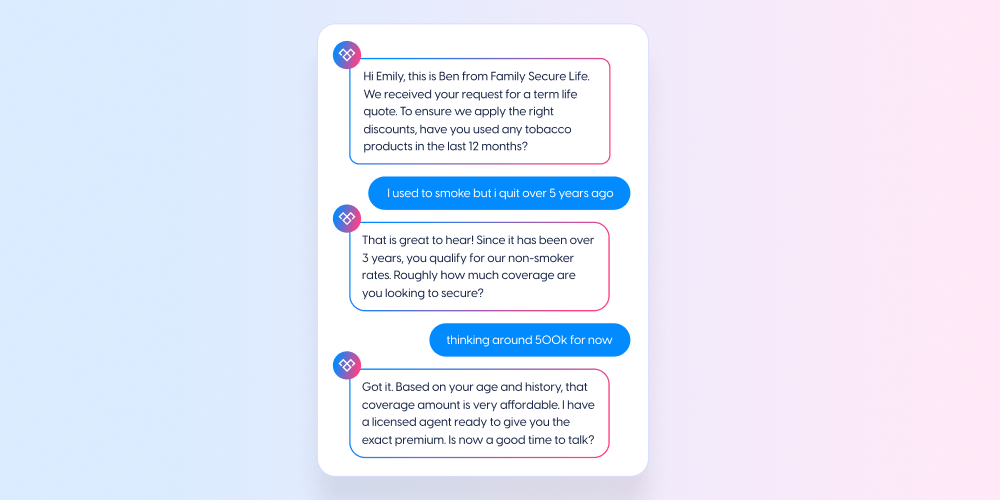
Texting works because it matches how people already communicate. SMS consistently outperforms email across key engagement metrics:
- SMS open rates exceed 90%
- Most texts are read within 3 minutes
But the real advantage of SMS isn’t just visibility: it’s continuity.
Texting turns a meeting from a static calendar event into an ongoing conversation. Instead of “a meeting on Thursday,” it feels like “something we’re already discussing.”
Effective SMS:
- Confirms intent in plain language
- Keeps context fresh
- Surfaces questions early
- Makes rescheduling feel easy, not awkward
This is why industries with chronic no-show problems (healthcare, education, field services) have increasingly shifted appointment workflows to SMS-first engagement.
Where Most SMS Strategies Break Down: Manual Work
Once teams realize SMS helps reduce no-shows, many enable texting inside their CRM or give reps company phones.
At first, it works.
Then volume increases.
Why manual SMS doesn’t scale
- Reps forget follow-ups during busy days
- Response times slip
- Messaging becomes inconsistent
- Threads pile up faster than humans can manage
Following up with no-shows, answering last-minute questions, and nudging reschedules quickly becomes a time tax on your best reps.
What started as a fix becomes another operational bottleneck.
What Scheduling Tools Like Calendly Get Right (and Where They Stop)
Scheduling platforms deserve credit. Tools like Calendly have significantly improved the booking experience.
Calendly’s no-show reduction features include:
- Automated email reminders
- SMS reminders (on paid plans)
- Easy rescheduling links
- Time-based reminder workflows
These workflows help reduce basic forgetfulness and improve baseline show rates.
But there’s a limit.
Calendly manages events, not conversations.
Its reminders are:
- Static
- Rule-based
- Non-responsive to replies or uncertainty
If a prospect replies with:
“Can we push this?”
“What is this meeting about again?”
“I’m not ready yet”
The system stops. A human must intervene.
This is where many no-shows quietly reappear.
The Gap Between Reminders and Real Engagement
Most no-show workflows are built on a flawed assumption: that people miss meetings because they forget.
In reality, no-shows usually happen because something unresolved sits between booking and meeting:
- The prospect feels uncertain
- They’re not fully sure what to expect
- They’re hesitating but don’t want to explicitly cancel
Traditional reminder tools can notify, but they can’t respond. When a prospect replies with a question or concern—and no one answers—hesitation turns into silence. And silence turns into no-shows.
This is the gap between notification and engagement.
Why AI-Driven SMS Changes the No-Show Equation
AI-driven SMS fills the space that reminder tools leave behind.
Instead of treating meetings as calendar events, Meera treats them as ongoing conversations. It doesn’t just remind prospects that a meeting exists—it keeps the dialogue alive between booking and show-up.
With Meera:
- Prospects can ask questions and get immediate responses
- Conversations feel natural, not automated
- Follow-ups happen gently and consistently, without rep involvement
- No-shows are automatically re-engaged and rescheduled
For teams already using scheduling tools like Calendly, Meera functions as the missing layer—or a practical alternative—when reminders alone aren’t enough to prevent no-shows.
From the buyer’s perspective, it feels like the conversation never stopped.
From the team’s perspective, it removes hours of manual follow-up while materially improving show rates.
Reducing No-Shows Without Adding More Work
This is the key shift.
The goal isn’t just higher show rates.
It’s higher show rates without increasing rep workload.
AI-driven SMS:
- Handles confirmations automatically
- Responds instantly to common questions
- Follows up with no-shows without rep involvement
- Routes only confirmed, qualified meetings to humans
According to internal estimates across multiple industries, automating follow-up and rescheduling can save teams 10–15 hours per rep per week—time that’s better spent on live conversations.
A Better Way to Think About No-Shows
No-shows aren’t a people problem.
They’re a system problem.
They happen when:
- Momentum isn’t maintained
- Questions go unanswered
- Follow-up relies on busy humans
SMS solves the communication gap.
AI automation solves the operational burden.
The teams that reduce no-shows most effectively don’t just remind prospects—they stay in the conversation.
And that’s the difference between a booked meeting and one that actually happens.
About the Author
.webp?width=46&height=46&name=sdfsd%20(1).webp)