











.svg)
.svg)

.svg)

.svg)
.png?width=512&height=512&name=guru%20(1).png)
.svg)


.png?width=199&height=109&name=salesforce-logo1-removebg-preview%20(1).png)





.svg)

.svg)
.svg)


.webp?width=716&height=569&name=banner-img%20(1).webp)


It's a system that can turn messy fast.
Many teams that deploy both voice and SMS outreach end up with two separate workflows that happen to share a lead list. The SMS tool runs its sequences. The calling tool runs its sequences. And somewhere in the middle, the lead is expected to pretend neither happened when the other channel reaches out.
That's not integration. It's parallel chaos.
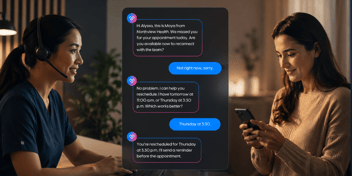
Done right, voice and SMS integration means a lead can receive a text, reply to it, get a follow-up call that picks up exactly where the text left off, and transfer to a live agent, all without being asked to repeat a single thing. The conversation is one thread. The channel is just how it gets delivered at any given moment.
Meera has launched thousands of AI-powered text messaging campaigns resulting in millions of individual conversations, and more recently expanded into voice AI. That vantage point informs everything in this guide. These are best practices we've seen work in practice, across insurance, lending, higher education, and home services.
Why Integrate Voice and SMS in the First Place?
Each channel has a distinct job.
SMS is where leads are most likely to engage first. Text messages carry an open rate around 98%, and because the medium is asynchronous, a prospect can respond when it's convenient for them rather than when they happen to be available for a call. For B2C sales environments where leads go cold fast (insurance, lending, home services, higher education), that response window matters enormously.
The Meera team knows from experience that voice carries something SMS can't fully replicate: nuance, urgency, and the kind of back-and-forth that closes decisions.
A live conversation, or even a qualified AI voice call, can compress a lead qualification process that might take days over text into a few minutes. And when a lead is ready to move, a warm phone transfer to a live agent is still one of the most effective ways to convert.
But here's the problem with relying on voice alone: it doesn't work the way it used to. According to our internal research analyzing survey responses from 464 B2C companies across insurance, financial services, higher education, and home services, 70% of sales teams need three or more call attempts just to get a lead on the phone.
In insurance specifically, that number climbs to nearly 90%. Leads aren't refusing to buy. They're refusing to pick up.
The problem is that most organizations run the two channels separately. The texting tool has no visibility into what the calling tool did. The rep on a call has no idea what happened in the text thread. The lead, caught between two disconnected experiences, ends up repeating their situation every time the channel switches. That repetition erodes trust and kills momentum.
“For 20 years, communication channels were built as silos,” Meera CEO Vivek Zaveri wrote in a Linkedin post. “Conversations don't live on one channel anymore. They move. Voice. SMS. Email. Whatever channel the customer is actually on at that moment.”
When voice and SMS are integrated correctly, you capture the strengths of both without the friction of switching between them.
The Core Principle: One Conversation, Not Two Channels
Before getting into specific practices, it helps to anchor everything to a single principle: the lead should never have to repeat themselves.
That sounds simple. In practice, it requires a shared conversation state that both channels read from and write to. Every text exchanged, every question answered, every signal of intent needs to live in one record that the voice channel can access at any moment, and vice versa.
When a lead tells your AI over SMS that they're looking for home insurance and just bought a house, that context should be present the moment voice enters the picture.
The AI calling them shouldn't open with "What are you looking for?" as though the text thread never happened. It should open with "You mentioned you're looking for home coverage before your move. I have a few quick questions before I connect you with someone."
That's what makes the experience feel like one conversation rather than two bots operating independently.
7 Best Practices for Voice and SMS Integration
As mentioned previously, our team has a unique perspective into what actually works for integrating SMS with voice. Here are some best practices we recommended following.
1. Carry Context Across Channels
Shared context is the technical foundation of good integration. This means a unified conversation log that both your SMS and voice systems can read, ideally synced back to your CRM so the full thread is captured against the lead record.
In practice: if a lead responds to an SMS and says they're ready to talk, the voice AI that calls them should reference that response. If a lead shared qualifying information over text, the voice call should not re-collect it. The data should travel with the conversation, not stay trapped in one channel's database.
This also matters for handoffs. When a qualified lead is transferred to a live agent, that agent should receive the full context (what channel the lead engaged on first, what they shared, where they are in their decision) so they can open the call mid-conversation rather than at the beginning of one.
2. Pick the Right Channel for the Moment
Channel selection logic determines which medium reaches the lead first and when to escalate. Getting this wrong is one of the most common integration mistakes.
A useful starting framework: text first, escalate to voice when intent is established. Most B2C leads will not answer a cold call from an unknown number. Research from Pew found that only 19% of Americans say they answer calls from unknown numbers. A text that arrives at the right moment, on the other hand, can open a conversation that a call never would have. Once a lead responds and expresses interest, voice becomes a natural next step.
The specific logic should account for factors like lead source, time of day, prior engagement history, and how the lead originally opted in. A lead from a web form submitted at 11pm may not be reachable by voice until mid-morning. A lead who clicked a quote request ad at 2pm is probably best reached within five minutes, across whichever channel responds first.
3. Build Smart Fallback Logic
Fallback logic determines what happens when a channel doesn't get a response. In a well-integrated system, no answer on one channel triggers outreach on the other rather than just queuing up another attempt on the same channel.
If a text gets no response after a set interval, a follow-up voice call can try the lead directly. If a call goes to voicemail, an SMS sent immediately after can reference the call:
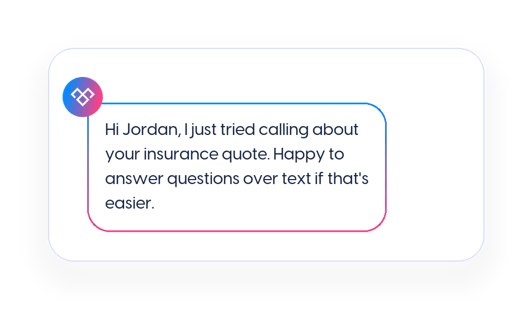
That message acknowledges the call attempt so the text doesn't feel disconnected, and opens a lower-commitment channel for the lead to engage on.
The goal of fallback logic isn't to increase contact volume. It's to find the channel the lead is most likely to engage with on that day, in that context.
4. Keep One Consistent Persona and Tone
One of the subtler ways voice and SMS integrations break down is when the two channels sound like different entities. The SMS conversation is warm and conversational. The voice AI is stiff and scripted. Or the voice call uses a different name than the texts did.
Consistency of persona across channels is what makes the experience feel like a single thread rather than a relay race. The AI should introduce itself the same way on both channels. If the SMS uses first names and casual language, the voice AI shouldn't pivot to formal address.
This extends to how the AI handles transitions. When voice picks up after an SMS exchange, it should explicitly acknowledge the text conversation: "You mentioned over text that you're looking for coverage before your move." That reference signals continuity and shows the lead that nothing was lost.
5. Time it Right
Speed-to-lead data consistently shows that the probability of reaching a new lead drops sharply within the first few minutes of inquiry. Research from the Harvard Business Review found that companies contacting leads within an hour of an online query were seven times more likely to have a meaningful conversation than those who waited longer, and more than 60 times more likely than companies that waited 24 hours.
For B2C sales teams, this means the first outreach should be automated and immediate. A rep becoming available is too slow a dependency when the lead is still at their computer, still engaged, still in the mindset that prompted the inquiry. The lead follow-up cadence after the first touch should be respectful of time zones and prior response signals. A lead who texted back at 9pm doesn't need a voice call at 7am.
Timing logic is one of the highest-leverage settings in a voice and SMS integration. Getting it right is the difference between a lead who feels served and a lead who feels harassed.
6. Design Clean AI-to-Human Handoffs
The handoff from AI conversation to live agent is where a lot of integrations fail. The AI qualifies the lead, establishes intent, warms them up, and then drops them into a hold queue or routes them to a rep who picks up cold.
A warm transfer is different. It means the lead doesn't wait, doesn't repeat themselves, and connects to someone who already knows their situation. For this to work, the handoff needs two things: a real-time transfer mechanism that connects the lead directly to an available agent, and a context summary the agent receives before or during the connection.
What that looks like in practice: the AI tells the lead, "I have everything I need. Connecting you with Sarah now. She already has your details so you won't need to repeat anything." The agent picks up with the lead already on the line and can open with something specific: "Hi Jordan, bundling home and auto before the move. Let's get you sorted."
That transition, when executed correctly, converts at a dramatically higher rate than a cold transfer or a callback queue. For more on how live call transfers work in practice, see Meera's warm transfer overview.
7. Stay Compliant on Both Channels
Voice and SMS carry distinct compliance obligations, and teams running both channels need to manage both.
For SMS, the Telephone Consumer Protection Act (TCPA) requires prior express written consent before sending automated texts to consumers. The CTIA Messaging Principles and Best Practices provide additional guidance on opt-in language, opt-out handling, and message content standards. Every SMS must include a clear opt-out mechanism, and opt-out signals must be honored immediately.
For voice, TCPA compliance also applies to automated or pre-recorded calls to mobile phones. STIR/SHAKEN is a call authentication framework designed to reduce spoofed caller ID, and carriers increasingly filter or label calls from numbers that fail attestation. Outbound AI voice programs that don't address STIR/SHAKEN registration are likely to see degraded answer rates over time. AI voice callers are also required to disclose that the caller is an AI when asked.
This is not legal advice. Organizations should consult qualified counsel for their specific situation. The practical point is that compliance belongs in the architecture from day one, not bolted on after a violation surfaces.
Common Voice and SMS Integration Mistakes to Avoid
Siloed channels with no shared context. Running an SMS tool and a calling tool side by side without integration isn't a voice and SMS strategy. It's two separate strategies that happen to share a contact list. Leads who engage on one channel will have to start over on the other.
Robotic scripting on voice. The failure mode of most voice integrations is an IVR experience masquerading as a conversation. Rigid scripts, decision trees, and menu-style prompts signal automation and get hung up on immediately. Voice AI in 2026 should be capable of dynamic back-and-forth, not reading a flowchart.
Ignoring consent before outreach. Sending automated texts or AI voice calls to contacts who haven't opted in is both a compliance risk and a brand risk. The opt-in mechanics need to be solid before scale.
Over-messaging the same lead on both channels simultaneously. Sending an SMS and making a call within seconds of each other feels aggressive and signals that the channels aren't coordinated. Sequence them with intent.
No path to a live person. AI-only journeys with no warm transfer option leave high-intent leads stranded at the moment they're most ready to convert. Every integration should have a clear escalation path to a human.
What to Look for in a Platform That Does Voice & SMS Well
 Most tools in this category do one thing well and approximate the other. A calling tool with an SMS add-on will have thin conversation logic on the text side. An SMS platform that bolts on voice will have a calling experience that feels disconnected.
Three criteria separate a true integration from two tools with a shared logo:
Context continuity. Does the voice channel know what happened in the SMS thread, and vice versa? Context stored in a single record that both channels read and write to is the baseline requirement.
Natural conversation on both channels. Can the AI handle dynamic responses, or is it running a script? The test is whether a lead who veers off the expected path gets a sensible response or a dead end. For more on what separates conversational AI from a chatbot, Meera's breakdown is worth reading.
Warm transfer capability. Real-time connection to a live agent with context passed through. Not a scheduled callback. Not a hold queue. A live transfer that the agent picks up mid-conversation.
How Meera Handles Voice and SMS as One Conversation
Meera's voice and SMS integration is built around the idea that both channels are part of a single conversation, orchestrated based on where the lead is most likely to engage.
Most workflows start with SMS. When a new lead comes in from a form fill, a quote request, or an event registration, Meera opens the conversation over text. The contact rate from a first text significantly outperforms a cold call to an unknown number, so SMS typically gets the conversation started before voice ever enters the picture.
Here's what that looks like for an insurance lead:
Meera (SMS): Hi Jordan, this is Meera from Riverside Insurance. You requested a quote online. Are you still looking for coverage?
Jordan: Yeah I am, just been busy.
Meera: Totally understand! I'll give you a quick call to go over your options. Does now work?
.png?width=463&height=445&name=Hi_Jordan_this_is_Meera%20(3).png)
Once the lead is engaged and has indicated they're open to a call, Meera's voice AI picks up the conversation. Not as a cold call, but as a continuation of the thread that already started.
Meera (voice): Hi Jordan, this is Meera calling from Riverside Insurance. You mentioned over text that you're still looking for coverage. I have a few quick questions before I connect you with one of our agents. Is that okay?
That opening references the text exchange explicitly. The lead doesn't have to re-establish who they are or what they want. The call picks up mid-conversation.
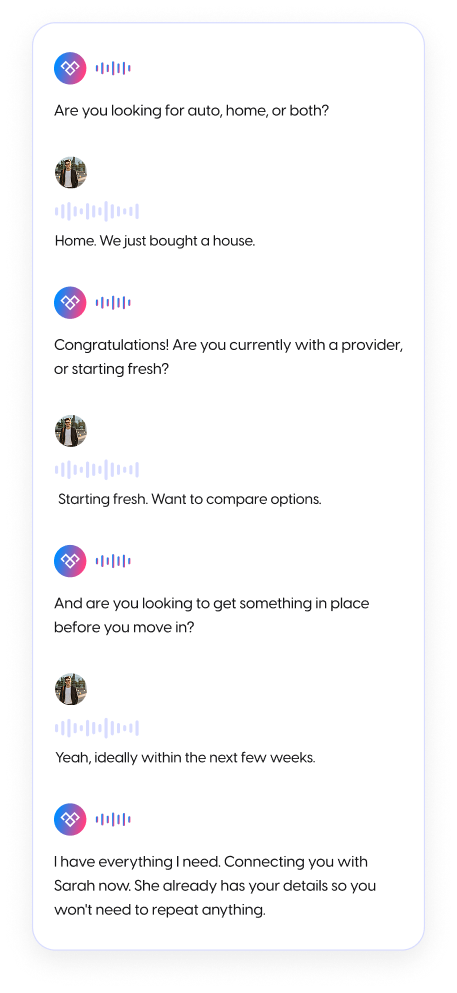
From there, Meera qualifies through a dynamic back-and-forth. One question at a time. Responses are adaptive, not scripted. If Jordan mentions they just bought a house, the next question follows that signal rather than continuing a predetermined sequence.
Meera: Are you looking for auto, home, or both?
Jordan: Home. We just bought a house.
Meera: Congratulations! Are you currently with a provider, or starting fresh?
Jordan: Starting fresh. Want to compare options.
Meera: And are you looking to get something in place before you move in?
Jordan: Yeah, ideally within the next few weeks.
Once qualification is complete, Meera warm-transfers directly to the right agent with full context already passed through. The lead doesn't wait on hold. The agent doesn't start from zero.
Meera: I have everything I need. Connecting you with Sarah now. She already has your details so you won't need to repeat anything.
Sarah: Hi Jordan. Bundling home and auto before the move. Let's get you sorted.
The same dynamic applies across Meera's verticals: higher education admissions teams re-engaging inquiry leads before enrollment deadlines, lending operations converting submitted applications into funded loans, and home services companies turning inbound inquiries into booked appointments.
The thread is continuous. The context travels. The agent closes.
Frequently Asked Questions
What is conversational AI voice and SMS integration?
Conversational AI voice and SMS integration is the practice of connecting automated voice and text channels so they operate as a single conversation rather than two separate outreach programs. In a properly integrated system, context from the text thread is available on the voice call and vice versa. The lead never has to repeat their situation when the channel switches, and a live agent who receives a warm transfer picks up with the full conversation history already in hand.
When should AI use voice vs. SMS?
The general best practice is to start with SMS, because contact rates from a first text significantly exceed those from a cold call. A lead who responds to a text is already in an active conversation before voice enters the picture. Voice becomes the right channel when intent is established, when the lead has engaged and expressed readiness to talk, or when the qualification process benefits from real-time back-and-forth. The specific trigger logic should account for lead source, time of day, and prior engagement signals.
How do you keep context between a voice call and a text?
Context continuity requires a shared conversation state that both channels read from and write to. Every message exchanged, every qualifying detail collected, and every intent signal captured in the SMS thread should be accessible to the voice channel before it dials, and the same record should update when the call occurs. This typically requires a unified conversation log that syncs to the CRM rather than storing records separately per channel.
What are the compliance requirements for AI voice and SMS outreach?
For SMS, the TCPA requires prior express written consent before sending automated messages to consumers. The CTIA Messaging Principles provide guidance on opt-in language, opt-out handling, and message frequency. For voice, TCPA compliance also applies to automated or pre-recorded calls to mobile phones. AI voice callers are required to disclose that the caller is an AI when asked. STIR/SHAKEN call authentication affects deliverability for outbound voice programs at scale. Organizations should consult qualified legal counsel for guidance specific to their situation.
What's the difference between multichannel and omnichannel conversational AI?
Multichannel means a platform supports more than one channel. Omnichannel means those channels are connected, with shared context, consistent persona, and a continuous experience for the lead across all of them. A team that runs separate SMS and voice tools without integration is multichannel. A team whose AI voice call references the prior text exchange and transfers to an agent who already has the full thread is omnichannel. The distinction isn't the number of channels. It's whether they behave as one conversation.
Putting It Together
The teams getting the most out of voice and SMS aren't the ones with the most dials or the most texts. They're the ones whose AI opens conversations leads actually want to continue, hands them off at the right moment, and makes sure the agent who picks up already knows who they're talking to.
That requires more than two tools running in parallel. It requires a platform that treats both channels as the same conversation.
To see how Meera handles voice and SMS integration as a single, context-aware thread, book a demo
About the Author