












.svg)
.svg)

.svg)

.svg)
.png?width=512&height=512&name=guru%20(1).png)
.svg)


.png?width=199&height=109&name=salesforce-logo1-removebg-preview%20(1).png)





.svg)

.svg)
.svg)


.webp?width=716&height=569&name=banner-img%20(1).webp)


Conversational Business Texting: How Two-Way Messaging Wins Customers
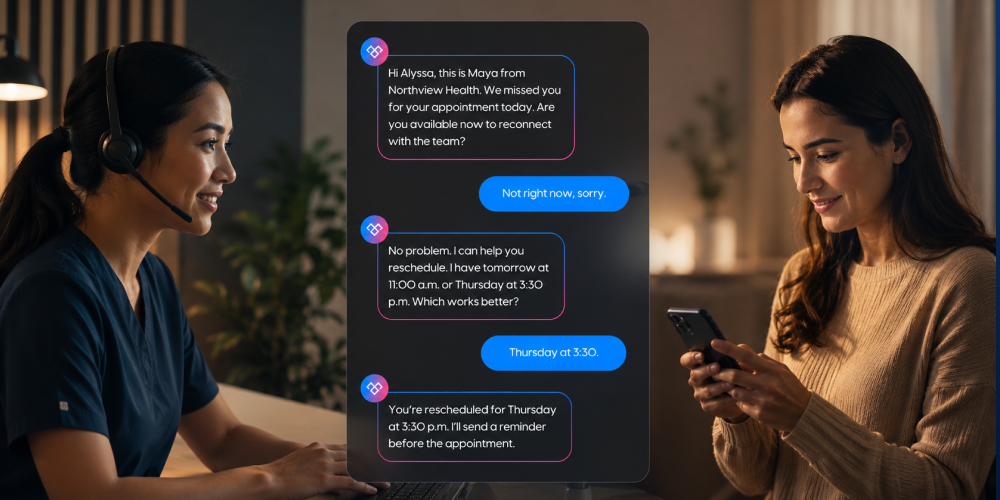
If your business sends texts but rarely gets a real conversation going, you are running into the limit of one-way messaging.
We see this often with the teams that come to Meera. They have a texting tool, they send reminders and promotions, and the numbers look fine on paper. But the channel is doing only half its job. It is broadcasting at customers when it could be talking with them, and the difference shows up where it counts: qualified leads, booked calls, and resolved questions.
That is the shift this guide is about. Conversational business texting is two-way by definition. It is the practice of having real back-and-forth text conversations with customers and leads across their entire journey, not blasting them with campaigns and hoping for a click.
Below we cover what it is, where it fits across your business, why it converts, and the honest part most guides skip: conversations do not scale with people alone, so doing this at volume means either more staff or AI that can actually hold the conversation.
What is conversational business texting?
Conversational business texting is two-way, one-to-one text messaging between a business and a customer or lead, where both sides can reply and the exchange moves forward like an actual conversation. It spans the full lifecycle: capturing and qualifying leads, following up on sales, answering support questions, sending reminders, and re-engaging people who have gone quiet.
The key word is two-way. A promotional blast sent to ten thousand contacts is texting, but it is not conversational. A back-and-forth where a prospect asks about pricing, gets an answer, asks a follow-up, and ends up booking a call is conversational. One informs. The other moves someone forward.
This is a real and growing expectation, not a nice-to-have. In its 2026 consumer report, EZ Texting found that texting is now the preferred channel for nine of ten common message types, and that consumers increasingly use text to reach businesses, not just to receive messages from them. Their takeaway for businesses was blunt: if you invite replies, be ready for them, because a fast channel sets fast expectations.
Conversational vs. bulk marketing SMS
The cleanest way to separate the two is dialogue versus broadcast.
Bulk marketing SMS is a one-to-many push. You send the same message to a list, and success is measured in opens and clicks. It is good for alerts, sales, and reminders. Conversational texting is a one-to-one exchange. Success is measured in replies, answers given, and leads moved forward. It is good for everything that requires the customer to actually say something back.
|
Bulk marketing SMS |
Conversational business texting |
|
|---|---|---|
|
Direction |
One-to-many broadcast |
One-to-one dialogue |
|
Goal |
Inform, promote, remind |
Qualify, convert, resolve |
|
Success metric |
Opens and clicks |
Replies and outcomes |
|
Best for |
Announcements, offers |
Sales, support, qualification |
Both have a place. The mistake is treating texting as only the first column. Adoption data backs this up: two-way messaging has been climbing as customers increasingly expect reply-based conversations rather than one-directional broadcasts.
Where it fits across the business
The competitors writing about this topic tend to frame it as a marketing tactic for online stores. That is too narrow. Conversational texting works across the revenue and service motion:
- Lead capture and qualification. Engage a new lead the moment they raise their hand, ask the questions that separate serious buyers from browsers, and use AI to qualify before a rep ever picks up.
- Sales follow-up. Keep a deal warm with timely, relevant replies instead of a voicemail nobody returns.
- Customer support. Let customers ask questions and get answers over the channel they already use all day.
- Reminders and scheduling. Confirm appointments, reschedule no-shows, and book meetings inside the conversation.
- Re-engagement. Restart conversations with leads who went cold weeks or months ago.
For Meera's customers in insurance, financial services, higher education, and home services, this breadth is the point. They depend on conversations, and texting is where those conversations now happen.
Why conversational texting works
The case rests on a simple reality: text is where people actually respond.
Open rates for SMS sit far above email, commonly cited around 98 percent against roughly 20 percent for email, and most texts are read within minutes of arriving. Response rates follow the same pattern, with text routinely outperforming email by a wide margin. When you ask a question by text, you tend to get an answer. When you ask it by email, you tend to get silence.
Speed compounds the effect. Meera's own study of 464 companies across insurance, finance, higher education, and home improvement found that nearly 70 percent of sales teams need three or more call attempts just to reach a single lead, and one in six need ten or more.
People now live in an asynchronous world and want to respond on their own time, which is exactly what a ringing phone refuses to allow. A text lets the customer answer when it suits them, and that single change is often what gets a stalled conversation moving.
This is what one-way blasts leave on the table. A promo blast can tell a thousand people about a renewal deadline. It cannot answer the one question standing between a customer and renewing. Conversation can.
The catch: conversations do not scale with people alone
Here is the part worth being honest about. Real two-way texting means someone has to reply, fast, every time, to every customer. That is wonderful when you have ten conversations going. It becomes a wall when you have ten thousand.
In practice, businesses have three options. Hire a bigger team, which is expensive and still caps out. Run a shared inbox, which helps but eventually drowns under volume and slows response times to the point where the speed advantage disappears. Or use AI that can genuinely carry the conversation.
This tension is exactly why so many texting programs quietly fall back to broadcasting. Two-way is the goal, but staffing it is hard, so the channel reverts to blasts.
One Meera customer told us they received 40 to 60 text replies and spent four to five hours a day sifting through them. Another capped agents at five simultaneous chats. The intent to converse was there. The human capacity was not.
How to do conversational business texting well
If you are setting this up or fixing a program that has drifted into blasting, these practices matter most.
- Get consent right. Two-way texting at scale runs on consent. Handle opt-in and opt-out properly, and pay attention to TCPA and 10DLC registration before you scale volume. Build this in from the start rather than retrofitting it.
- Reply fast. A text channel sets a text-speed expectation. Aim to respond in seconds, not hours, especially for new leads where speed to contact decides who wins the deal.
- Keep it genuinely two-way and natural. Invite replies and answer them like a person would, one question at a time. Robotic, scripted messaging undoes the whole advantage. Meera designs for this directly through DialogueDesign.
- Qualify and route. Use the conversation to learn who is ready and who is not, then send the ready ones where they need to go.
- Connect it to your CRM. Conversations should write back to your system of record so sales and support see the full history.
- Design a clean human handoff. The moment a conversation needs a person, the path should be short. Customers want to know a human is reachable, so make the transfer seamless rather than a dead end.
Conversational business texting with Meera
Here is how it comes together in practice.
A home services company runs ads that generate a steady flow of inquiries. Each new lead wants a fast answer about availability and pricing, and the office cannot call every one of them the instant they come in. Leads that wait go cold, and the team burns hours chasing people who never pick up.
With Meera handling the conversation, a new inquiry gets a text within seconds. Meera answers the common questions, confirms what the customer needs, qualifies whether it is a real job, and books the appointment or warm-transfers the ready customer to a person while interest is high. It does this across SMS and voice, using natural conversation rather than a rigid script, and it does it for every lead at once instead of capping out at five.
This is not a marketing blast with a reply option bolted on. It is the two-way conversation running at a scale a human team cannot match, with people stepping in exactly when they add the most value. Meera works the same way across its other verticals, anywhere a business depends on conversations to convert.
Frequently asked questions
What is conversational business texting? It is two-way, one-to-one text messaging between a business and a customer or lead, where both sides reply and the exchange moves forward like a real conversation. It covers lead qualification, sales follow-up, support, reminders, and re-engagement, not just promotional broadcasts.
How is conversational texting different from bulk SMS marketing? Bulk SMS is a one-to-many broadcast measured in opens and clicks. Conversational texting is a one-to-one dialogue measured in replies and outcomes. Blasts inform; conversations qualify and convert.
Is business texting compliant with TCPA and 10DLC? It can be, when consent, opt-out handling, and number registration are managed correctly. Build compliance in before scaling volume, and confirm requirements with your own legal counsel.
Can you automate conversational texting without sounding robotic? Yes, but not with a basic keyword bot. A conversational AI agent interprets what someone means and responds in context, rather than matching a fixed script, which is what keeps automated texting from feeling robotic.
What is the difference between a texting shared inbox and an AI texting agent? A shared inbox routes texts to human staff and works until volume outpaces the team. An AI texting agent holds the conversation itself at scale, answers and qualifies automatically, and escalates to a person when needed.
The takeaway
Blasts inform. Conversations convert. Conversational business texting is two-way by definition, and that is exactly why it works, because it lets customers reply, ask, and move forward on the channel they already prefer.
The honest catch is that conversations do not scale with people alone. Doing this well at volume takes either a larger team or AI capable of actually carrying the conversation without sounding like a bot.
About the Author

Grant Weherley