












.svg)
.svg)

.svg)

.svg)
.png?width=512&height=512&name=guru%20(1).png)
.svg)


.png?width=199&height=109&name=salesforce-logo1-removebg-preview%20(1).png)




.svg)

.svg)
.svg)


.webp?width=716&height=569&name=banner-img%20(1).webp)


Automated Loan Reminders: How Lenders Cut Delinquencies Without Cutting Staff
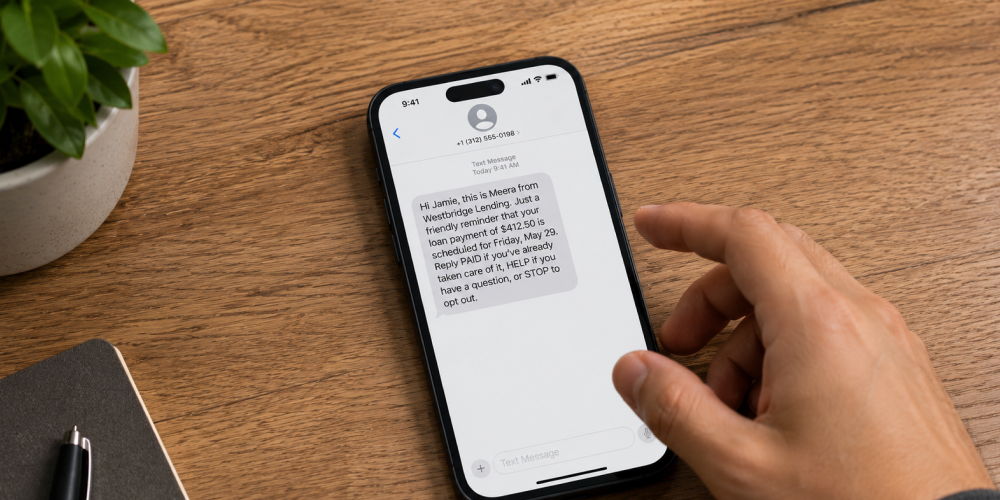
Lenders are stuck in an uncomfortable position. And it might be getting worse.
Payment reminders matter more than they ever have, borrowers expect a faster and more digital experience, and most lending teams are running with the same headcount they had three years ago. The math doesn't work. You can't ask a finite team to do an infinite amount of outreach tasks and expect delinquencies to drop.
Automated loan reminders solve this problem. They handle the high-volume, repetitive outreach that drives most of the delinquency reduction in a lending portfolio, freeing loan officers and servicing staff to focus on the conversations that actually require a human.
At Meera, we serve an array of lending clients (from mortgages to personal loans) and providing automated reminders is a popular use case. This guide is based heavily on what we learned. It walks you through what automated loan reminders are, where they create the most value, how to evaluate a platform, and what lenders are seeing once they deploy them.
What are automated loan reminders?
Automated loan reminders are software-driven notifications that contact borrowers about their loan without a person dialing the phone or writing each message.
They cover pre-due-date payment reminders, past-due outreach, escrow and rate change notifications, appointment confirmations, refinance offers, welcome messages for new borrowers, and any other recurring borrower touchpoint a servicing or sales team would otherwise handle manually.
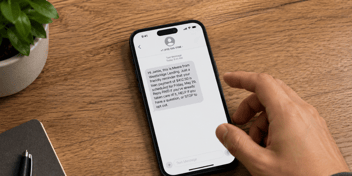
The simplest versions are one-way blasts: a templated SMS or email goes out on a schedule, the borrower reads it, and that's the end of the interaction. More advanced platforms run two-way conversational AI that can answer borrower questions, take payment commitments, route hardship cases to a live agent, and update the core system of record automatically.
The category has matured fast because the underlying problem keeps getting worse. Borrowers don't answer unknown phone numbers, email response rates keep sliding, and lending teams are expected to do more with less. That's why AI SMS marketing for lending is becoming more popular.
Why manual loan reminders fall short
Most lenders started with manual outreach for a reason. A loan officer calling a borrower personally feels like the right thing to do. The problem is that manual outreach breaks in four predictable ways once a portfolio scales past a few hundred active loans.
The volume problem
A single loan officer can realistically make about 60 to 80 outbound calls in a productive day. If a borrower doesn't pick up, that call has to be repeated. With a portfolio of several thousand loans, the basic arithmetic doesn't work. Reminders get skipped, follow-ups get dropped, and the borrowers who most need a nudge are often the ones who don't get one because they're harder to reach.
The timing problem
Loan reminders are time-sensitive. A payment reminder sent the day after a payment was due is far less useful than one sent two days before. A welcome call placed three weeks after funding is useless. Manual outreach can't hit every borrower at the optimal moment because loan officers are working through a queue, not responding to triggers.
The consistency problem
Two loan officers talking to two borrowers about the same missed payment will give two different conversations. This can lead to the borrower getting conflicting information. One officer might offer a deferment option, the other might push for immediate payment.
That inconsistency is a compliance problem, especially under CFPB Regulation X early intervention requirements, which obligates mortgage servicers to make good-faith efforts to establish live contact within 36 days of delinquency and provide written notice by day 45. Manual processes make it hard to prove that contact was attempted, when, and how.
The channel problem
Phone calls are the default channel for most manual outreach, and phone calls are increasingly being ignored. Pew Research found that 80% of Americans don't answer their cellphone when an unknown number calls. That means even a perfectly executed manual call campaign is reaching maybe one in five borrowers on the first attempt. The rest require follow-up calls, voicemails, and emails that further compound the volume problem.
How automated loan reminders actually work
A modern automated loan reminder system connects to a lender's core banking system or CRM, watches for trigger events, and sends the appropriate message through the appropriate channel at the appropriate time.
The triggers can be date-based (payment due in 5 days), event-based (escrow analysis completed, application stalled at document upload), or behavior-based (borrower clicked a payment link but didn't complete the payment).
Once the trigger fires, the platform sends a message. If the borrower replies, conversational AI handles the response. A borrower asking "can I push my payment to the 15th?" gets routed differently than one asking "what's my balance?"
Simple questions get answered automatically. Complex situations get warm-transferred to a live agent with the full conversation history attached. Every interaction is logged for compliance, and the core system gets updated so the loan officer sees the latest status the next time they open the account.
The important thing is that this isn't a text blasting tool. Good automation handles the conversation, not just the send.
5 ways automated loan reminders help officers save time
Automated reminders apply across the borrower lifecycle, but five use cases consistently produce the most measurable impact for lending teams.
1) Pre-due-date payment reminders
The cheapest delinquency to prevent is the one that hasn't happened yet. A reminder sent 3 to 5 days before a payment is due catches the borrowers who simply forgot, who switched bank accounts, or whose autopay failed. This single use case typically produces the largest reduction in 30-day delinquency because it intercepts the borrowers who would have paid on time if they'd been reminded.
2) Early-stage past-due outreach
Once a payment is missed, the cost of recovery climbs fast. Industry research from the Mortgage Bankers Association has shown that servicing a non-performing loan can cost more than ten times what it costs to service a performing loan. Early-stage outreach (days 1 through 30 past due) is where automated reminders earn their keep.
Borrowers who'd respond to a polite text often won't respond to a collections call, and reaching them before the situation escalates keeps them out of the more expensive parts of the servicing workflow.
3) Escrow and rate change notifications
Escrow analyses, ARM resets, and payment changes generate predictable spikes in inbound calls. A borrower who gets a letter explaining their payment is going up next month will often call to ask why. An automated message that explains the change in plain language, answers common questions, and offers to schedule a call with a loan officer for anything more complex can deflect 60 to 80% of those inbound calls without anyone feeling brushed off.
4) Refinance and modification outreach
Refinance opportunities are perishable. When rates drop, the window to capture refis is short, and lenders compete with every other lender in the market for the same borrowers. Automated outreach can identify eligible borrowers from the existing book, send a personalized message about the savings opportunity, qualify their interest, and book a call with a loan officer for the ones ready to talk. The same workflow applies to loan modification offers for borrowers showing early signs of distress.
5) Welcome calls for new borrowers
A welcome touchpoint within the first 30 days of funding sets the tone for the entire relationship. Borrowers who feel attended to early are easier to reach later when something goes wrong.
Automated welcome messages can confirm payment setup, walk borrowers through the servicing portal, answer the most common new-borrower questions, and flag anyone who seems confused or unhappy for a follow-up call. Done well, this single touchpoint reduces the volume of first-payment defaults and early-stage delinquencies that come from borrowers who never quite understood how their loan worked.
SMS vs voice vs email: which channel works best for loan reminders?
The short answer is SMS, with voice and email as supporting channels. The longer answer is that each channel has a specific job.
SMS wins for most loan reminders because it gets read. Text messages have an open rate around 98%, compared to roughly 20% for email, and the average response time for an SMS is 90 seconds versus 90 minutes for an email. Borrowers don't ignore texts the way they ignore unknown phone numbers, and they don't lose them in a cluttered inbox. For routine reminders, payment confirmations, and quick questions, SMS is the right default.
Voice still matters for two specific situations. The first is loss mitigation conversations, where regulatory requirements often mandate live contact and where the empathy of a human voice changes the outcome.
The second is high-value moments like loan closings, where a phone call signals importance. Modern platforms can start a conversation over SMS and warm-transfer it to a live voice call when the borrower is ready to talk, which is the best of both worlds.
Email is useful for delivering documents, statements, and detailed information that doesn't fit in a text. It's not the channel to lead with for reminders, but it's the right channel for the supporting material once the reminder has been delivered. The lenders getting the best results use all three channels and let the platform decide which one fits the moment.
What to look for in an automated loan reminder platform
Most platforms in this category look similar on a feature list. The differences show up in production. Five things matter more than the rest.
Compliance controls
Lending is one of the most heavily regulated communication environments in business. The TCPA requires prior express written consent for automated calls and texts to wireless numbers, and the FCC has been tightening the rules.
The one-to-one consent rule affects how lead-generated borrowers can be contacted. State-level rules add another layer. A platform that doesn't have purpose-built compliance controls (consent tracking, time-of-day restrictions, quiet hours, opt-out honoring across channels, audit logs) will create more problems than it solves.
Real two-way conversational AI
There's a big gap between a tool that sends a templated text and a tool that can hold a conversation. Borrowers don't just acknowledge reminders; they reply with questions, hardships, scheduling requests, and confusion about their account.
A platform that can only send and not respond will still leave loan officers managing the inbox. Look for AI that can handle natural-language replies, escalate appropriately, and learn from the conversations it has.
Core banking and CRM integrations
If the reminder platform doesn't know that a borrower already paid, it will send a past-due reminder to someone who's current. That kind of error destroys trust faster than anything else. Real integrations with the loan origination system, the servicing platform, and the CRM (whether that's Salesforce, HubSpot, or something else) are what make automated reminders feel personal instead of robotic. The platform should know what the loan officer knows.
Warm transfer to live agents
Automation should know its limits. When a borrower says they lost their job, or asks a question that requires a licensed loan officer, or just sounds frustrated, the platform should hand the conversation to a person with full context attached. A warm transfer is the difference between a borrower who feels heard and a borrower who feels processed. The good platforms make this seamless. The bad ones drop the conversation entirely and force the borrower to start over.
Reporting and analytics
Lending leaders need to see what's working. That means contact rates broken down by channel and campaign, response rates by message type, conversion to scheduled call or completed payment, time saved per loan officer, and compliance attestation reports that satisfy an audit. A platform that runs a black box is a liability.
The business case: what lenders actually see
The financial case for automated loan reminders comes from three places: lower delinquency rates, lower cost-to-collect, and freed-up capacity in the sales and servicing teams. The numbers vary by portfolio mix, geography, and operational maturity, but the pattern is consistent across the lenders deploying these systems.
On the delinquency side, the savings compound. A single missed payment that gets cured at day 5 instead of day 35 doesn't just save the cost of the collection workflow. It also prevents the credit reporting that damages the borrower's score, the late fees that strain the relationship, and the downstream risk that one missed payment becomes three.
On the cost side, the math is direct. Each loan officer hour that gets reallocated from manual reminder calls to revenue-producing activity (new applications, complex hardship cases, refinance conversations) has a real dollar value.
Most lenders find that automated reminders handle 70 to 90% of the routine outreach volume, which translates to one or two full-time-equivalent loan officers worth of capacity per several thousand active loans.
On the capacity side, the value shows up as growth without hiring. A team that was capped at a certain number of new loans per month because the existing book required so much manual servicing can now grow the book without adding people. That's the version of the ROI story that resonates most with CFOs.
Real-world example: Level Financing
Level Financing is a lender operating in the competitive personal loan space, where speed-to-lead determines who funds the loan and who watches the borrower take their business elsewhere. The company was collecting high-intent leads from a variety of online sales funnels, but its outreach process was manual. Loan officers couldn't contact every new lead fast enough, and a lot of warm leads were going cold before anyone could call them.
Level deployed Meera's AI texting to automate the first touch. New leads now get contacted within 15 seconds of opt-in. Meera explains the loan process, answers basic questions, and books a call with a loan officer for the qualified borrowers.
For existing loans, Meera also sends reminders for overdue payments, incomplete applications, and upcoming calls.
The results: 43% of new leads responded to Meera's initial outreach. 55% of those who responded became qualified leads. And 97% of the qualified leads went on to book a call with the Level Financing team through Meera. You can read the full Level Financing case study here.
How Meera automates loan reminders for financial services teams
Meera is a conversations platform that gets leads and customers on the phone without the constant chasing. This tool can increase the efficiency of lending teams by a wide margin.
Meera contacts new leads within 15 seconds of opt-in, which captures borrowers when their interest is highest. For existing loans, Meera handles pre-due-date payment reminders, past-due outreach, application completion nudges, escrow and rate change notifications, refinance opportunity outreach, appointment confirmations, and welcome messages for new borrowers.
The conversational AI handles the routine questions automatically and warm-transfers complex situations to a live loan officer with the full conversation history.
Compliance controls are built in, which matters in lending more than almost anywhere else. Every conversation is documented, opt-outs are honored across channels, and time-of-day restrictions follow TCPA and state-level rules without anyone on the team having to remember them. Meera integrates with the systems lending teams already use, including Salesforce, HubSpot, and the major contact center platforms.
The point isn't to replace loan officers. It's to make sure their time goes where it produces revenue and customer goodwill, not into the manual reminder work that an AI can handle just as well at a fraction of the cost.
Frequently asked questions
Are automated loan reminders TCPA compliant?
They can be, but the platform matters. TCPA requires prior express written consent for automated calls and texts to mobile numbers, and the FCC has been adding requirements like one-to-one consent and faster opt-out processing. A purpose-built lending platform will track consent at the individual borrower level, honor opt-outs immediately across all channels, and produce the audit logs needed to demonstrate compliance. A generic SMS tool used without those controls is a liability.
Will borrowers find automated reminders annoying?
Most borrowers prefer them, as long as the messages are relevant and useful. A text reminding someone their payment is due in 3 days is helpful. A text trying to sell them a refinance they didn't ask about is not. The difference is targeting and tone. Borrowers consistently rate text-based reminders as their preferred way to be contacted for routine account matters.
Can automated reminders replace loan officers?
No, and they shouldn't try to. The goal is to handle the high-volume, repetitive outreach automatically so that loan officers can spend their time on the conversations that require human judgment: hardship cases, complex applications, refinance discussions, and relationship-building with high-value borrowers. Lenders who try to fully replace their loan officers with automation usually regret it. The ones who use automation to amplify their loan officers tend to grow the book without growing the team.
How quickly can a lender deploy automated loan reminders?
Most lenders are running their first campaigns within a few weeks, depending on how complex the integrations are. A simple deployment that connects to an existing CRM and sends pre-due-date reminders can be live in days. A more sophisticated rollout that integrates with the core servicing platform and handles multiple use cases takes longer, but it's still measured in weeks rather than months.
About the Author

Grant Weherley