













.svg)
.svg)

.svg)

.svg)
.png?width=512&height=512&name=guru%20(1).png)
.svg)


.png?width=199&height=109&name=salesforce-logo1-removebg-preview%20(1).png)





.svg)

.svg)
.svg)


.webp?width=716&height=569&name=banner-img%20(1).webp)


Healthcare SMS Marketing: The Patient-Journey Playbook (With Templates)
Your patients read their texts. They don't open the email, and they don't return the call about the appointment they're overdue for.
But that text message always gets read.
SMS marketing is also where many healthcare companies get into trouble. "Healthcare texting" is two jobs sharing one name, and the line between them is legal, not stylistic. One side is care logistics, the other is marketing. Blur them and you've handed a plaintiff's firm a fact pattern. Keep them straight and you fill a schedule that was going to sit half empty.
So here's the definition worth holding onto: SMS marketing in healthcare uses text messaging to attract, retain, and re-engage patients. It covers transactional messages like reminders and billing notices, sent under healthcare-operations consent, and promotional campaigns like reactivation and new-service offers, which require prior express written consent.
This guide is about the second kind. What to send, who's allowed to get it, and how to handle the replies that turn a campaign into a booked appointment. It’s based on Meera’s experience sending millions of text messages on behalf of healthcare customers over the past year.
The Line That Governs Everything: Transactional vs. Promotional
Every text you send a patient is either care or marketing. Which one it is decides what consent you need, what the message can say, and how often you can send it.
|
Message type |
Example |
Consent required |
|---|---|---|
|
Appointment reminder |
"Your visit with Dr. Lee is Tues at 2pm. Reply C to confirm." |
Prior express consent; may qualify for the FCC's healthcare exemption |
|
Recall or preventive care |
"You're due for your annual exam." |
Prior express consent, care-related, no offer attached |
|
Billing or payment notice |
"Your balance is ready to view in the portal." |
Prior express consent; excluded from the healthcare exemption |
|
Patient reactivation |
"We have openings this month if you'd like to come in." |
Prior express written consent |
|
New-service or elective offer |
"We've added evening appointments for [service]." |
Prior express written consent |
|
Seasonal or benefits campaign |
"Your benefits reset Dec 31." |
Prior express written consent |
The FCC's 2015 declaratory ruling lets covered entities text certain healthcare messages without prior express consent: appointment and exam reminders, wellness checkups, pre-registration instructions, pre-operative notifications, and home healthcare instructions. It's a shorter list than most people assume, and it comes with seven conditions:
- The message goes only to the number the patient gave you.
- It states the provider's name and contact information.
- It runs 160 characters or less.
- It offers an easy opt-out, which you honor immediately.
- One message per day, three per week, per provider.
- No telemarketing, solicitation, or advertising content.
- Nothing about billing, accounting, or debt collection.
That last one is where practices slip. Tack a whitening special onto a cleaning reminder and it isn't a reminder anymore. It's a marketing message wearing a reminder's consent record, which is the exact mismatch attorneys go looking for.
The Transactional Layer, Briefly
Reminders, confirmations, and billing notices aren't marketing, but they're what makes marketing possible later. A practice that's been useful over text gets read when it eventually sends an offer. One that shows up cold with a promotion doesn't.
This piece won't re-teach that layer. The reminder mechanics (cadence, confirmation logic, reschedule handling) are covered in our guide to SMS appointment reminders, and the patient-specific rules, including reminder-level HIPAA questions, are in medical appointment text reminders.
Two things to carry forward, though. Billing and payment texts sit outside the FCC's healthcare exemption, so they need their own consent basis rather than riding along with reminders. And no ePHI belongs in any message body: not results, not diagnoses, not the name of the procedure. Point to the portal and leave the detail behind the login.
The Promotional Playbook: Five Campaigns That Fill a Schedule
These five campaigns each follow the same format: who receives it, what triggers it, what the message says, and what happens when someone replies. Every sample message is marked transactional or promotional, so you know which consent standard applies before you send it.
1. Patient reactivation
The best text a practice can send, for a simple reason: these people already chose you once.
Audience: patients with no visit in 12 to 24 months, segmented by last-visit date, scrubbed against your opt-out list.
Trigger: a monthly batch, or a rolling trigger at a set number of months since the last visit. Follow-through: replies go to a scheduler who can offer real times.
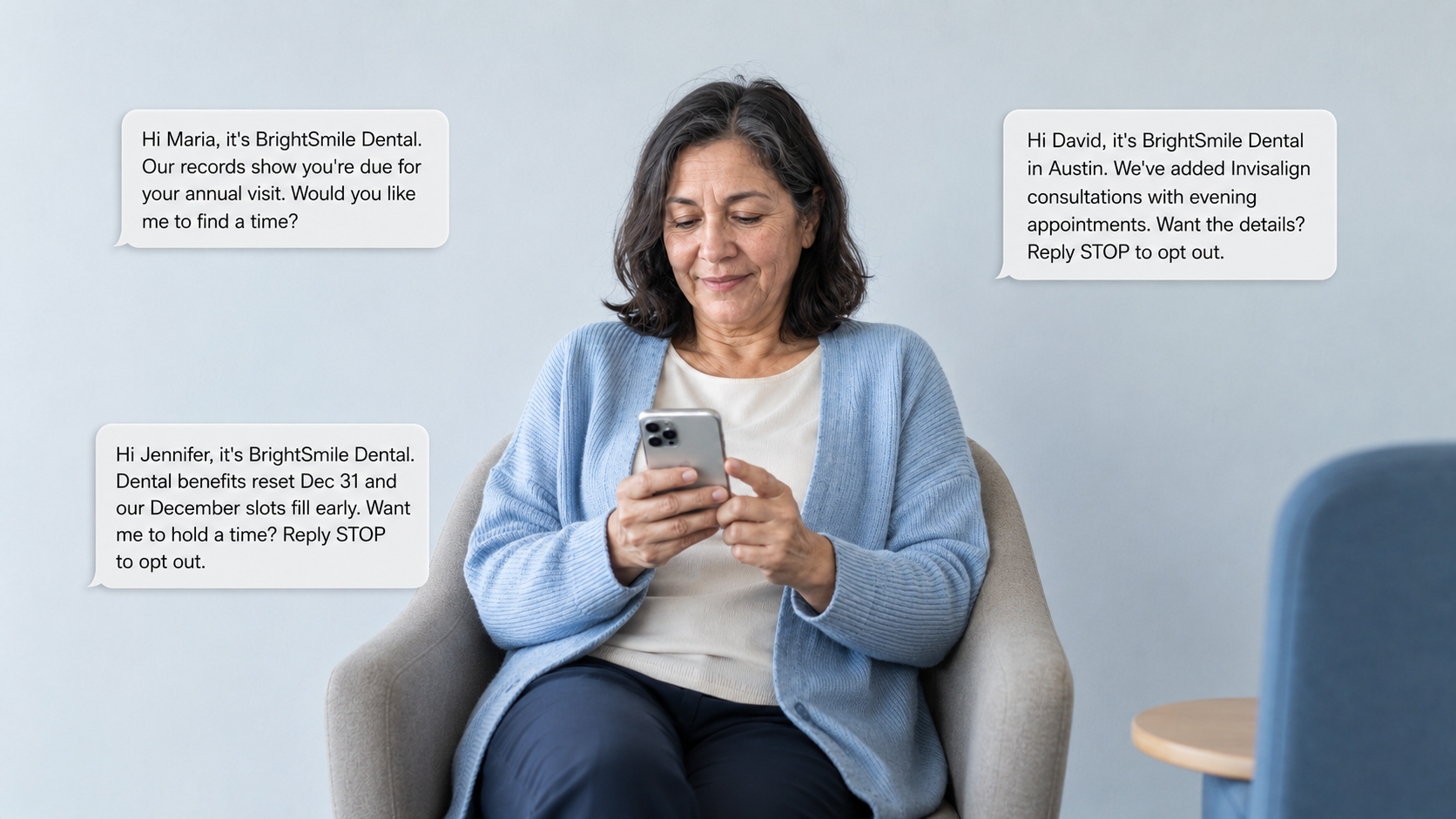
"Hi [First name], it's [Practice] in [City]. It's been a while since we've seen you and we have openings this month. Want me to check a few times for you? Reply STOP to opt out."
2. Recall and preventive-care campaigns
Cleanings, annuals, screenings, flu season. Segment by due date, not by your marketing calendar.
Audience: patients with a care interval that's due or overdue.
Trigger: the due date, with one follow-up if nobody replies.
Follow-through: book in the thread, or hand off to the front desk.
"Hi [First name], it's [Practice]. Our records show you're due for your annual visit. Would you like me to find a time?"
3. New-service and elective awareness
Marketing, full stop, and it should be aimed rather than blasted. Send it to patients whose history or stated interest makes the service relevant.
Audience: an interest-based or history-based segment. Never the whole list.
Trigger: a service launch, a new provider, new evening availability.
Follow-through: be ready for the three questions that always come back. Price, timing, coverage.
"Hi [First name], it's [Practice] in [City]. We've added [service] with evening appointments. Want the details? Reply STOP to opt out."
Elective and cash-pay practices get the most out of this one, since the decision belongs to the patient alone and the message carries less sensitive information to begin with.
4. Seasonal and event-based campaigns
Benefits deadlines, allergy season, back-to-school physicals, open enrollment. These land because the urgency is real.
Audience: whoever the season applies to.
Trigger: the calendar, early enough that you still have slots to give away.
Follow-through: a booking, or a "remind me next month" that genuinely fires next month.
"Hi [First name], it's [Practice]. Dental benefits reset Dec 31 and our December slots fill early. Want me to hold a time? Reply STOP to opt out."
5. Reviews and reputation
The post-visit ask, routed on the answer. Sentiment first, then decide what to do with it.
Audience: patients seen in the last 24 to 48 hours.
Trigger: visit completion.
Follow-through: a 4 or 5 gets the review link. A 1 through 3 gets a human being, not a link.
"Hi [First name], thanks for coming in today. How did your visit go, 1 to 5?" → 4-5: "Glad to hear it. Would you mind sharing that here? [link]" → 1-3: "Sorry to hear that. Can I have our office manager reach out today?" Consent line: the satisfaction check is health care operations; the public review ask leans promotional. Run it under marketing consent to be safe.
Routing unhappy patients to a person instead of a review page isn't a trick to bury feedback. It's the difference between fixing a problem and publishing it.
The Reply Is the Campaign
A reactivation text doesn't make you any money. A booked appointment does, and what sits between them is a reply nobody answered.
Send 2,000 reactivation texts on a Tuesday morning and here's what comes back: "can I do Tuesday?", "is this covered?", "who is this?", "wrong number." All of it during clinic hours, while your front desk is checking people in. Unanswered replies never show up in a report. They show up as a flat month.
There's a ladder here. At the bottom, blasts with nobody watching the inbox. A step up, a shared inbox with someone assigned, which works until volume outgrows the person. At the top, two-way conversational automation: replies handled in minutes, at any hour, ending in a booked slot or a warm handoff to staff.
Compliance: Consent, HIPAA, and 10DLC
Not legal advice, but every claim here traces to the FCC or HHS directly. Have your legal counsel review your program regardless.
Getting consent. Promotional messages need prior express written consent: a clear disclosure, an affirmative act, and a timestamped record you can still produce three years from now. Collect it at intake, on digital forms, and at booking. A pre-ticked box, or texting permission buried in a treatment consent, won't survive a challenge.
Letting them out. Since April 2025, patients can revoke consent by any reasonable method. STOP, quit, end, revoke, opt out, cancel, and unsubscribe are all automatically valid, and you have 10 business days to honor it. You get one confirmation text, and it can't try to talk them out of leaving. The related "revoke-all" provision, which makes a single opt-out apply to every unrelated message type from the same sender, has been pushed back twice and now lands January 31, 2027. If you run several message streams, build for it now.
HIPAA at the marketing layer. HHS guidance requires written authorization before PHI is used for marketing, with narrow exceptions, and disclosure when a third party pays for the communication. Practically: keep clinical detail out of campaign copy, use portal prompts instead of specifics, and ask any vendor whether they'll sign a business associate agreement before you send a single patient message through them.
10DLC. Business texting on US carrier networks runs through registered 10DLC campaigns. Unregistered traffic gets filtered, throttled, or dropped, which is why a campaign can look perfectly sent and never arrive. Register the brand and the use case, then keep what you send matched to what you registered.
Measuring What Matters
Delivery and open rates tell you the message left the building. They don't tell you whether anyone sat in the chair.
Track replies per campaign, bookings out of those replies, reactivated patients who showed up, and revenue per campaign. Watch opt-out rate as your fatigue alarm: the trend matters more than the number, and a jump usually means frequency or targeting rather than copy.
And ignore the benchmarks floating around this topic. Chase most published response and opt-out figures for healthcare texting and you'll find a marketing blog citing another marketing blog. Run one campaign, write down your own numbers, compare against those. Our SMS benchmarks piece is a general starting point, not a healthcare-specific one.
Frequently Asked Questions
Is SMS marketing legal in healthcare? Yes, with consent. Marketing texts to a patient's wireless number need prior express written consent under the TCPA, and if the message uses protected health information, HIPAA requires written authorization on top. Care messages like reminders run on a narrower, separate basis.
Do patients have to opt in to marketing texts from a doctor's office? Yes. The FCC's healthcare exemption covers reminders, wellness checkups, and similar care messages, and specifically excludes anything with telemarketing, solicitation, or advertising in it. Handing over a phone number at intake isn't consent to receive offers.
Is SMS marketing HIPAA compliant? It can be, as long as campaign copy carries no protected health information, you have authorization where HIPAA calls for it, and any vendor touching patient data has signed a business associate agreement. HIPAA compliance is something your program has, not something you buy off a shelf.
What should a patient reactivation text say? Name the practice, mention the gap in plain language, make one specific ask, include an opt-out: "Hi [First name], it's [Practice] in [City]. It's been a while since we've seen you and we have openings this month. Want me to check a few times? Reply STOP to opt out." Leave clinical detail out.
How often should a medical practice text patients? Care messages under the FCC exemption cap at one a day and three a week per provider. For marketing, one or two a month per segment works for most practices. Watch the opt-out trend and ease off when it climbs.
About the Author

Grant Weherley