













.svg)
.svg)

.svg)

.svg)
.png?width=512&height=512&name=guru%20(1).png)
.svg)


.png?width=199&height=109&name=salesforce-logo1-removebg-preview%20(1).png)




.svg)

.svg)
.svg)


.webp?width=716&height=569&name=banner-img%20(1).webp)


A lot of “SMS marketing” still looks like marketing from 2014.
Blast a list. Add emojis. Toss in a discount. Hope for the best.
But that’s not where the future of SMS marketing lies.
At Meera, we’ve tested hundreds of AI-powered text messaging campaigns and sent millions of messages across multiple industries. One takeaway shows up again and again:
People don’t want to be interrupted anymore.
In 2026, SMS will become the primary engagement layer for revenue teams because it matches how people actually communicate now: asynchronously, on their own time, on a device they never put down.
And the teams that win won’t be the ones who text more.
They’ll be the ones who text more respectfully. Here’s what we mean by that.
The old outreach playbook is collapsing under its own noise
We’ve watched the industry try to solve declining connect rates with one solution:
More volume.
Faster dialers. “AI calling.” More attempts per lead.
But when the channel is broken, volume is just a more expensive way to learn the same lesson.
We ran a survey across 464 companies in sales-driven industries and found that nearly 70% need three or more call attempts just to reach a lead, and ~1 in 6 need 10+ attempts.
That’s not a sales skill issue.
That’s a communication preference issue.
Cold calling data points in the same direction. Cognism, using WHAM data, reported a 4.82% cold calling “success rate” (conversations that resulted in a meeting booked) for 2025.
Even if you debate the exact number, the trend is obvious: calls are getting harder, and the marginal cost of a “real conversation” keeps rising.
And it’s not happening in a vacuum.
Robocalls are still everywhere. YouMail’s Robocall Index reporting (via press coverage) pegged 2025 U.S. robocalls at 52.5B, barely down from 2024 levels. On the consumer side, the FTC still received 1.1M robocall complaints in FY2024.
So customers do what rational people do: they protect their attention. Unknown numbers get ignored. Voicemails get deleted. Email gets skimmed… if it gets opened at all.
SMS wins because it’s the least interruptive way to start a conversation
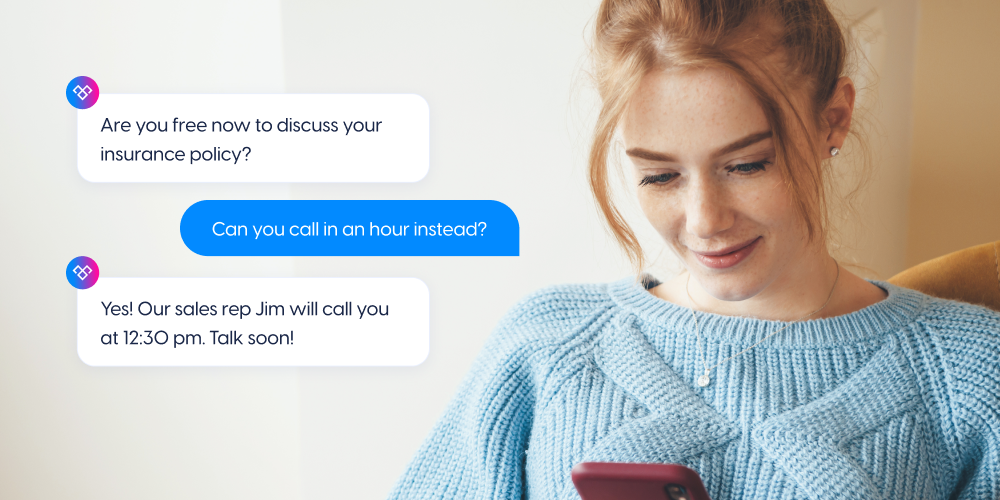
Here’s the misconception: SMS works because it’s short.
No.
SMS works because it respects the customer’s autonomy.
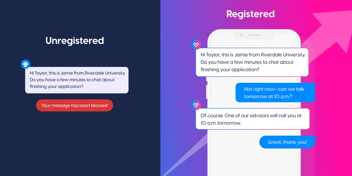
A call demands your attention right now. A text gives you control.
And the performance delta is still huge. Text messages have a 98% open rate.
That’s why SMS keeps becoming the “default” channel for high-intent moments:
- inbound lead follow-up
- appointment scheduling
- re-engagement
- “are you still interested?” nudges that don’t feel like harassment
The future isn’t texting people more aggressively.
It’s using messaging to make the next step feel easy.
Speed-to-lead still matters. It just can’t be annoying.
Every revenue leader knows the speed-to-lead story. The problem is most teams can’t execute it consistently without burning out reps.
InsideSales (XANT) analyzed 55M+ sales activities and found that conversion rates are 8x higher when response happens in the first five minutes.
So yes—speed matters.
But speed without relevance is just faster spam.
That’s why “SMS marketing” in 2026 stops being campaign-first and becomes conversation-first:
- respond instantly when intent is high
- slow down when intent is unclear
- ask one helpful question instead of sending five messages
- earn the right to continue
AI changes everything… if it adapts to humans (not the other way around)
The next wave isn’t “AI that sends texts.”
It’s AI that manages timing, tone, and handoff like a great human would.
That’s the line I keep coming back to:
- Outreach only works when it respects preference
- Engagement only works when it feels natural
- AI only works when it adapts to humans, not the other way around
In practice, the best AI messaging systems do a few things really well:
1) They don’t force synchronous behavior
They let the customer reply in 30 seconds or 3 hours without breaking the experience.
2) They qualify before they escalate
They gather missing context and confirm intent so the human conversation starts warm.
3) They orchestrate the moment of connection
If a call is needed, it happens when the customer is ready, not when a rep happens to have a gap.
That last part matters more than most people realize. Meera’s own research on B2C follow-up points out that most teams need multiple calls to reach someone, which means dialing harder isn’t a strategy—it’s a tax you keep paying.
Compliance becomes the moat (and the reason lazy SMS dies)
One thing that will be true in 2026:
SMS will keep getting more regulated and more enforced.
That’s good.
If messaging is going to remain a high-trust channel, carriers and regulators will keep tightening requirements. We’re already seeing this through stricter A2P/10DLC expectations and evolving registry standards.
The outcome is predictable:
- spammy “text blast” behavior gets filtered or blocked
- legitimate brands that do opt-in and governance well get better deliverability
- strategy (and restraint) becomes a competitive advantage
In other words: the channel rewards respectful operators.
What “SMS marketing” looks like in 2026
It doesn’t look like marketing.
It looks like a helpful assistant that:
- follows up instantly
- asks one clear question
- handles the common back-and-forth
- knows when to stop
- knows when to hand off
- logs the outcome cleanly
And it treats the customer like a person, not a “lead.”
That’s the real future:
Less interruption. More relevance. More respect.
Because the future of outreach isn’t louder.
It’s smarter.
It’s human.
And it’s on the customer’s terms.
About the Author
.webp?width=46&height=46&name=sdfsd%20(1).webp)