










.svg)
.svg)

.svg)

.svg)
.png?width=512&height=512&name=guru%20(1).png)
.svg)


.png?width=199&height=109&name=salesforce-logo1-removebg-preview%20(1).png)




.svg)

.svg)
.svg)


.webp?width=716&height=569&name=banner-img%20(1).webp)


Why Omnichannel Messaging Is Essential for B2C Sales in 2026
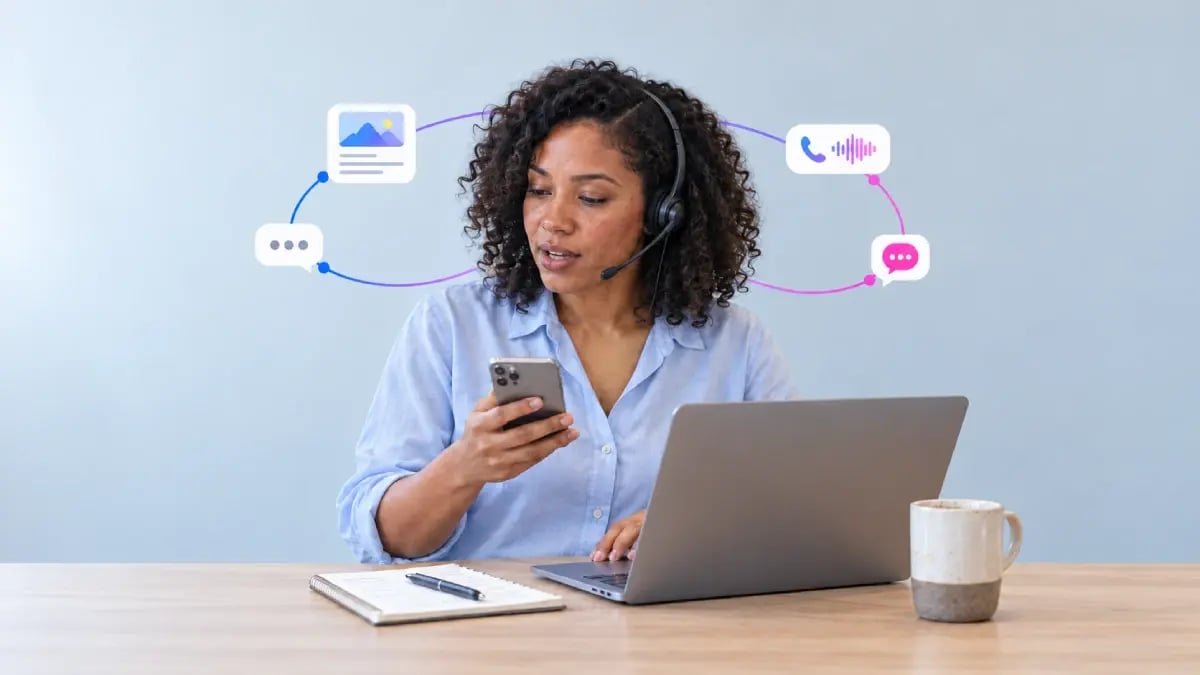
Omnichannel messaging means running SMS, voice, RCS, web chat and other channels from one conversation record, so each lead is reached on the channel and at the moment they are most likely to respond. One conversation, not several running in parallel.
Meera has now run more than 35 million SMS interactions for B2C sales teams, and text remains the channel with the highest response rate we have seen. Our 2025 benchmarks show that clearly. Those same years of data also taught us something less convenient. Some leads only convert once the conversation moves to a live call. Some never engage on the first channel at all. And even a strong text campaign hits a ceiling once the numbers behind it get flagged.
That is why Meera has spent the past year adding channels such as Voice AI, RCS and Web Chat. Meera founder and CEO Vivek Zaveri put the underlying problem plainly in a recent LinkedIn post:
"The hard part was never the conversation. It's getting someone to actually talk to you in the first place."
So this guide takes a different angle than most. It covers what omnichannel messaging actually is, why most setups wearing the label are really multichannel, and how to build around reachability instead of channel count.
What is omnichannel messaging (in a B2C context)?
Omnichannel messaging coordinates every channel a business uses to reach a person, so that person experiences one conversation no matter where it happens. Say a lead replies to a text on Monday and answers a call on Wednesday. Whoever is on that call already knows what was said in the thread, and the lead never has to start over.
Three properties separate a true omnichannel setup from a collection of tools. There is a shared conversation history that every channel reads from and writes to. There is a single decision layer choosing which channel comes next for each person. And the switch between channels is invisible to the lead.
Most definitions you will find online come from customer service platforms, where omnichannel means a support agent can see a customer's chat, email and phone history in one inbox. Useful, but it describes inbound support with a customer who has already decided to talk to you. Lead engagement is a harder problem. The person filled out a form or clicked an ad, and the business still has to earn the conversation.
Omnichannel vs. multichannel messaging
|
Multichannel |
Omnichannel |
|
|
Channels |
Several, each in its own tool |
Several, one system |
|
Conversation history |
Separate per channel |
Shared across every channel |
|
Who picks the next channel |
A fixed sequence, or a rep guessing |
A decision layer working per person and per moment |
|
Cadence |
Same schedule for everyone |
Follows the moment someone is reachable |
|
What the lead experiences |
Repeats themselves, hears the same pitch three times |
One conversation that picks up where it left off |
Notice that channel count does not decide which column a team lands in. You can run SMS, email and phone and still be multichannel if those three live in three tools with three different views of the same lead. The shift to omnichannel happens when one system holds the conversation and decides what comes next.
Why single-channel outreach is breaking
The case for omnichannel used to rest on customer experience. In 2026 it rests on something more basic: whether contact happens at all.
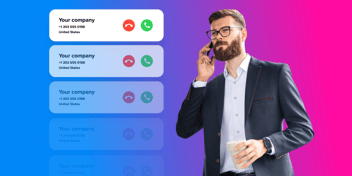
Voice is the clearest example. Hiya's 2026 State of the Call report, based on a survey of more than 12,000 consumers across six countries, found that 86% of calls from unknown numbers go unanswered. Just 14% of people pick up right away. Everyone else rejects the call or waits to see whether a voicemail shows up.
B2B benchmarks tell the same story from the seller's side. Cognism's State of Cold Calling reports put the average cold call success rate at 4.82% in 2024, 2.3% in 2025 and 2.7% in the 2026 edition. The slight recovery is worth noting, but the channel is still running at roughly half the level it held two years ago.
Phone makers are now formalizing the behavior Hiya measured. Apple's iOS 26 introduced Call Screening, which answers unknown calls in the background and asks the caller to state their name and reason before the phone rings. Google Pixel has offered Call Screen since 2018, and the major carriers apply spam labels at the network level. In other words, an unknown number now has to get past a gatekeeper before a person ever sees it.
SMS has held up far better, which is why Meera opens with it. Across those 35 million interactions, text still earns replies at a rate no other outbound channel comes close to. That said, text has its own friction. Carrier registration, filtering and simple reply fatigue mean some messages go unread, and a text thread alone rarely closes a complex sale.
Email sits at the bottom of the urgency scale for B2C leads. It is fine as a supporting touch, confirming details or sending documents. As a first contact for someone who requested a quote ten minutes ago? Usually too slow to matter.
Zaveri's read is that the industry has been optimizing the wrong variable:
"As the agents themselves get commoditized, reachability becomes the thing that actually matters. Getting connected is a lot harder to copy than sounding good on a call."
The four channels that matter for B2C lead engagement
Each channel has a job. Getting the assignments right is most of the work.
SMS: the opener
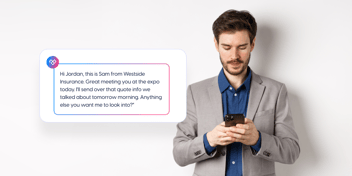
Text is asynchronous, low friction, and the channel people already use with friends and family. A short first message that says who is reaching out and why gets read even when a call would be ignored. Its limit is depth. A text thread can qualify, answer questions and book a time. The decisions that need a human conversation, though, still need a human conversation.
RCS: the trusted opener
RCS adds a verified sender name, logo, buttons and carousels to mobile messaging. That verification matters when the first message has to establish trust with someone who has never heard from you. Coverage still varies by device and carrier, so SMS remains the foundation and RCS extends it where it is available. Meera's RCS overview covers what the channel can and cannot do today.
Voice: the closer
Voice is the best channel for qualification, objection handling and the moment a lead is ready to commit. It is also the worst first-touch channel, for every reason in the previous section. Voice works when the lead already knows who is calling and why, which is exactly what a text thread provides. Meera's Voice AI follows that order. It reaches leads who have engaged over text but have not yet booked, confirms identity, qualifies intent, and transfers the ones who are ready to a live agent.
Web chat: the peak-intent moment
Someone on your pricing page at 9 p.m. is at the highest intent they will have all week. Web chat catches them right there. Its limit is that the conversation ends when the tab closes, unless the thread continues over SMS.
WhatsApp fills the same role as SMS for international and multilingual audiences, and email remains a supporting channel for confirmations and documents.
How omnichannel messaging works in practice: the async-to-sync sequence
Definitions are easy to find. What most guides skip is the actual sequence a lead goes through, so here is one pattern Meera has settled on after millions of conversations.
Step 1: Open on text within seconds. The first message establishes who is reaching out and why. Speed matters here more than anywhere else in the funnel.
Step 2: Engage and triage in the thread. The conversation answers questions, qualifies the lead and works out what they need next. Booking a time and answering basic objections both happen here.
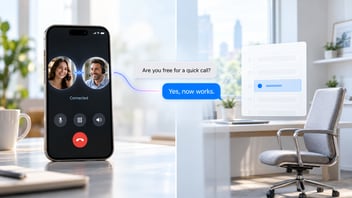
Step 3: Move to voice when the lead is ready. This is the async-to-sync transition. Three outcomes are possible: a warm transfer to an available agent with full context, a booked meeting if no one is free or the lead prefers later, or a text conversation that keeps going until the timing is right.
Step 4: If a call goes unanswered, fall back to text. Redialing an unanswered number is the fastest way to get flagged. Reopening the thread keeps the conversation alive and gives the lead a low-pressure way back in.
Level Financing shows what the first three steps look like in lending. New leads are contacted within 15 seconds of opt-in, 43% respond to the first outreach, 56% of contacted leads qualify, and 97% of those qualified leads go on to book a call with the team.
Why Meera has been adding channels (and what comes next)
Meera started with SMS because that is where replies happen. Simple as that. Across millions of conversations, though, the same three failure modes kept showing up no matter which channel we looked at. Numbers get flagged as volume climbs. The same channel gets used on everyone instead of the one that fits the person and the moment. And cadence follows a schedule rather than the moments someone is actually reachable.
Meera Reach™ is the reachability layer built to address those three problems. It pairs a patent-pending dialing algorithm, which assigns the right number to the right person and maintains a consistent calling identity instead of treating numbers as disposable inventory, with the async-to-sync orchestration described above across SMS, RCS, Voice AI and Web Chat.
Reach is agent-agnostic. It works with the agents a team already has, human or AI, and hands off the connected conversation with full context. Before your agents can have a conversation, you have to make the connection. The how it works page walks through the full flow.
Voice AI and RCS were the most recent additions, and more channels are on the way. The logic is the same every time: add the channel where a lead is reachable, then keep it inside the same conversation.
How to evaluate an omnichannel messaging platform for lead engagement
Plenty of platforms support several channels. Far fewer orchestrate them. These five questions will tell you which kind you are looking at.
- Does one conversation record follow the lead across every channel? A good answer: the person answering the call can see the text thread, and the next text references the call. A weak answer: channels are "integrated" through a CRM sync that runs every fifteen minutes.
- Who decides which channel comes next? A good answer: the platform chooses per person, based on what that person has responded to and when. A weak answer: you build one fixed sequence and everyone gets it.
- What happens when a call is not answered? A good answer: the platform opens another path, usually text, and waits for a signal before trying voice again. A weak answer: it redials on a schedule.
- How does it protect calling and texting identity? A good answer covers number health monitoring, STIR/SHAKEN attestation, branded caller ID and 10DLC registration, and explains who manages each one. The FCC's call authentication rules make attestation a baseline, and a vendor that cannot explain its approach is a risk to your contact rates.
- Can it hand off to the people or AI you already use? A good answer: warm transfer to an available agent, or a booked meeting, with the full conversation attached. A weak answer: it only works with its own agents, or it passes along a phone number and nothing else.
Common omnichannel messaging mistakes
- Blasting every channel at once. A text, a call and an email about the same thing within ten minutes reads as harassment, and it burns the lead on all three channels.
- Leading with voice on unknown numbers. This walks straight into the 86% figure. Earn recognition first.
- Treating phone numbers as disposable inventory. Rotating numbers to dodge spam labels destroys calling identity and trains carriers to flag you faster.
- Adding a channel through a separate tool. A new channel with no shared history is another silo, and a lead who has to repeat themselves has been handed a reason to stop replying.
- Measuring volume instead of connection. Dials made and messages sent are activity metrics. Contact rate, response rate and transfer rate describe whether omnichannel is working.
Frequently asked questions
What is the difference between omnichannel and multichannel messaging? Multichannel means using several channels. Omnichannel means those channels share one conversation history and one decision layer, so the lead experiences a single conversation. Running SMS in one tool and calls in another is multichannel. One system choosing the next channel per person, with full context, is omnichannel.
Which channel should a sales team start with? Text, in nearly every B2C case. It is the channel most likely to earn a reply from someone who does not yet recognize you, and it creates the context that makes a later call answerable.
Is SMS or voice better for lead follow-up? They do different jobs. SMS is better at getting the first reply. Voice is better at qualifying and closing. The sequence that works is text first, voice once the lead has engaged.
What is RCS, and do I need it? RCS is the successor to SMS, with verified sender identity, rich media and interactive buttons. It is worth using where it is supported, particularly for the first message, but SMS coverage is still universal and RCS is not. Treat it as an extension rather than a replacement.
How fast should the first message go out? Within seconds. Level Financing's 15-second first contact and LifeWest's move away from a ten-minute lag both point the same way. A lead's attention peaks at the moment of inquiry and decays quickly.
Does omnichannel messaging require replacing a contact center platform? Not necessarily. Some teams run a reachability layer on top of an existing dialer or CCaaS stack and let it handle the front end of the conversation. Others consolidate. The right answer depends on how much of the current stack is contributing to the flagging and cadence problems described above.
About the Author

Grant Weherley