














.svg)
.svg)

.svg)

.svg)
.png?width=512&height=512&name=guru%20(1).png)
.svg)


.png?width=199&height=109&name=salesforce-logo1-removebg-preview%20(1).png)





.svg)

.svg)
.svg)


.webp?width=716&height=569&name=banner-img%20(1).webp)


Lead Response Management: How to Reach Leads Before They Go Cold
Every sales team has a lead they lost because nobody got to it in time. Most have a few hundred, sitting in the CRM with a last-touched date from a month ago.
Lead response management is the process meant to stop that pile from growing: get to a new lead while they still care, find out if they're worth a rep's time, and get them to the right person before they drift off to a competitor.
The idea dates back to 2007, when a study asked how long you have before a web lead goes cold. The answer was minutes, and it built an industry around calling faster. Twenty years on, calling faster mostly gets you to voicemail sooner. The lead sees a number they don't know and lets it ring. Speed still matters. Reaching someone who will actually pick up matters more.
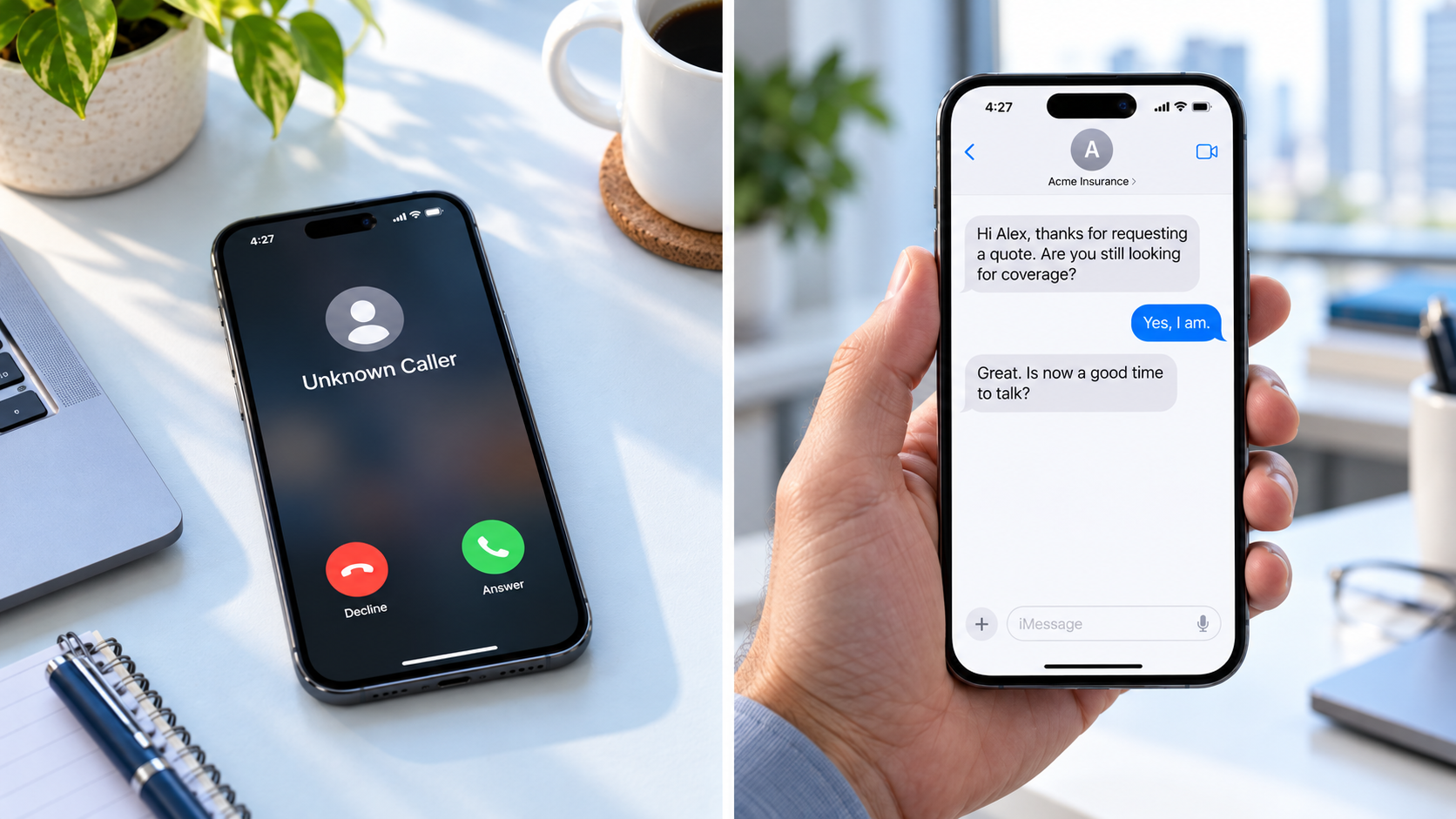
The guides skip what happens after the five-minute callback. The lead's phone rings. The screen shows an unknown number. Eight in ten people let it ring through. The response was on time, but the contact never happened.
That gap between responding and reaching is where high-volume sales teams lose leads now. Across the lending, insurance, and admissions teams we work with, the pattern repeats: the first touch lands late, or it lands on time on a channel the lead ignores. Closing both gaps is what lead response management means today.
What lead response management covers
Four decisions make up the discipline. Each one moves contact rate on its own, and they compound.
- Speed. Time from opt-in to the first outbound attempt.
- Channel. Where that attempt lands: a call, a text, an email.
- Persistence. How many attempts follow, how far apart, and when to stop.
- Handoff. How an engaged lead reaches the right person while still engaged.
Lead management is the wider term for everything from capture to close. Lead response time is one metric inside lead response management, and the one most vendors reduce the topic to. The original researchers defined "contact" as a live conversation lasting at least two minutes. A dial that rings out is an attempt. Keeping that distinction decides which numbers you track later.
What the research measured
The 2007 study by InsideSales.com and Dr. James Oldroyd, then at MIT, analysed three years of call data from six companies: more than 15,000 web leads and 100,000 dial attempts. The odds of contacting a lead fell 100 times between a five-minute callback and a 30-minute one. The odds of qualifying the lead fell 21 times. Within the first hour, the odds of contact dropped by a factor of ten.
A companion survey of 495 companies from the Kellogg School found that each tier of delay in first response cut qualification rates by 4.3%, and each unproductive call attempt cut them by a further 5%. The finding that gets less attention: 38% of companies could not say how long their own first attempt took, and those companies posted the weakest rates of all.
Harvard Business Review audited 2,241 US companies in 2011 by submitting a test lead to each one. Only 37% responded within an hour. Among companies that responded at all, the average was 42 hours. Nearly a quarter never responded.
One line from the MIT data deserves more weight than it gets. After 20 hours, every additional dial to the same lead reduced the odds of ever making contact. Repeating the attempt on the same channel had a cost, and the researchers said so in 2007.
The researchers offered three reasons speed works. The lead is still at the keyboard, so the phone is within reach. Interest peaks at the moment of the request and decays from there. And an immediate response impresses people; they take the company to be organised and attentive.
Why the five-minute rule is harder than it looks
Pew Research found in 2020 that 80% of US adults let calls from unknown numbers go unanswered; 19% generally pick up. A five-minute callback now competes with the caller ID screen, and the screen usually wins. Prospects who submitted a form on their phone are holding the device when it rings. Many still decline.
Coverage is the second problem. One rep works one lead at a time during business hours. Lead volume arrives in bursts: a campaign goes live, an event ends, an ad set catches fire at 9 p.m. The response-time average looks fine, and the leads that arrived in the burst waited hours.
Data quality is the third. Web forms carry typos, transposed digits, and numbers that belong to someone else. A first attempt to a wrong number spends the five-minute window with nothing to show for it.
Teams that hit five minutes on paper often hit it with a dial that rings out and an email that sits unopened. Response time looked healthy on the dashboard. Contact rate did not move. That is the pattern we see most often when a team first shares its numbers with us.
Five practices that raise contact rates
1. Respond within seconds, and let software make the first touch
A human does not need to be the first responder, only the first conversation. An automated text at opt-in can acknowledge the request, ask one qualifying question, and give the lead an easy way to reply, all inside the window when they are still looking at their phone. The rep joins once the lead answers.
Measure it: median time from opt-in to first outbound touch, by lead source.
2. Lead with the channel that gets a reply
For consumer leads, text first. A text arrives without an unknown-caller decision, sits on the lock screen until the lead reads it, and takes seconds to answer. Move to a call once the lead agrees to one. Where the lead came in by phone or chat, match that channel first. Texting a new lead requires prior express consent, collected at the form, and the sending number must be registered with carriers. See our SMS best practices for the details.
Measure it: contact rate by channel, where contact means a reply or a live conversation.
3. Persist on a schedule, with a stop rule
Several touches over several days, spaced out, with a defined point where the sequence ends. Vary the channel between attempts rather than repeating the same dial; the 20-hour finding shows that repeated calls to the same number eventually hurt. A text after an unanswered call reaches the lead where the call could not.
Measure it: attempts to first contact, and share of leads contacted by the end of the sequence.
4. Route on readiness, not rotation
Round-robin distributes work evenly. Readiness routing sends the lead to a person the moment the lead says yes, either as a warm transfer while they are on the line or as a booked appointment at a time they chose. The handoff happens inside the same conversation, so the lead never has to be re-contacted.
Measure it: share of qualified leads that reach a live conversation or booked slot, and time from qualification to handoff.
5. Track contact and qualification, not just response time
The Kellogg survey's clearest finding was that companies who did not measure performed worst. Response time is the easiest number to collect and the least informative on its own. Four numbers together describe the system: time to first touch, contact rate by channel, qualification rate by response-time bucket, and lead age at first contact. A team that watches all four can see whether a slow week came from timing, channel, or data.
The second half: leads that already went cold
A large share of leads never get a live conversation in that hour, and they stay in the CRM with a last-touched date that keeps aging. Re-engaging them is lead response management applied late, and the same rules hold: fast to reply once they respond, on the channel they will answer, with a clear handoff.
The re-approach that works is short, references the original request, and asks a question the lead can answer in one word. Admissions and lending teams we work with get replies from leads six months old and older when that message arrives as a text rather than a call, because the text asks nothing of the lead beyond a glance.
Measure it: reply rate and booked rate on leads older than 30 days, tracked separately from fresh leads.
How to build it: reps, call center, or automation
Three ways to run lead response, compared on the constraints that decide contact rate.
|
In-house reps with a dialer |
Outsourced call center |
Automated conversational outreach |
|
|
First touch at 9 p.m. or on a weekend |
Next business day |
Covered, at a per-hour rate |
Within seconds, every day |
|
Cost per contact |
High: rep time per dial, most dials unanswered |
Medium to high: paid per minute or per agent |
Low: software handles the first touches |
|
Channels |
Phone and email |
Phone first; some offer text |
Text, voice, and email, chosen per lead |
|
Consistency |
Varies by rep and by day |
Consistent script, limited context on each lead |
Same sequence on every lead, with CRM context |
|
Handoff |
The rep is already on the call |
Transfer to your team, if reachable |
Warm transfer or booked appointment inside the conversation |
Whichever route you choose, five capabilities decide the outcome: a first touch under a minute, text and voice in the same system, consent and quiet-hour handling built in, routing tied to your CRM, and a handoff that puts the lead on the phone with a person. Working with an expert on campaign design and carrier registration shortens the setup.
Meera was built for the reach problem. It contacts a new lead within seconds on the channel most likely to get an answer, holds the conversation, and puts ready-to-talk prospects on the phone with your team. Meera Reach™ works out the best channel for each lead, so the first touch lands where the lead will see it.
Frequently asked questions
What is a good lead response time?
Under five minutes, based on the MIT research. Under one minute is routine with automated first touches. The number that matters more is contact rate at that response time; a five-minute dial that goes unanswered is a five-minute response with no contact.
What is the difference between lead response time and lead response management?
Lead response time is one metric: the elapsed time from a lead's request to the first attempt to reach them. Lead response management is the whole process around that attempt, including channel choice, follow-up cadence, routing, and measurement.
Should the first response be a call or a text?
For consumer leads who submitted a web form, a text first, then a call once they agree to one. If the lead phoned in or opened a chat, respond on that channel first. Any text requires prior express consent collected at opt-in.
How many follow-up attempts are enough?
Enough to reach most leads who intend to respond, with a defined stop. The MIT data showed repeated dials past 20 hours lowered the odds of contact, so persistence works best when the channel changes between attempts. A sequence that mixes text and call over several days outperforms the same call repeated.
About the Author

Grant Weherley