













.svg)
.svg)

.svg)

.svg)
.png?width=512&height=512&name=guru%20(1).png)
.svg)


.png?width=199&height=109&name=salesforce-logo1-removebg-preview%20(1).png)



.svg)

.svg)
.svg)


.webp?width=716&height=569&name=banner-img%20(1).webp)


AI Real-Time Call Transfer: How to Hand Off Leads at the Moment of Peak Intent
A lead just said they're ready to talk. Right now.
Whether a human reaches them in the next 30 seconds or the next 30 minutes will largely decide whether they convert. That window is what AI real-time call transfer is built to close.
But the way different vendors close it reveals two very different ideas about what call transfer is for. One school of thought treats every transfer as a cost to minimize. The other treats it as the moment a sale gets made. This guide covers what AI real-time call transfer is, the three forms it takes, and what separates a setup that converts leads from one that just routes calls.
What is AI real-time call transfer?
AI real-time call transfer is when an AI system connects a live caller to a human agent on the fly, deciding when to transfer, who to transfer to, and what context to pass along, based on the conversation itself.
Traditional call transfer relies on menu trees ("press 1 for sales") or manual hold-and-dial steps where one agent puts you on hold and tries to find another. That process takes time, frustrates callers, and almost always means the caller has to repeat themselves once a human finally picks up.
AI real-time call transfer collapses all of that. The AI listens to the conversation, identifies intent and readiness, checks who's available, and connects the caller to the right person. The transfer takes seconds rather than minutes, and in the best implementations, the receiving agent already knows why the caller is on the line before they say hello.
You'll see the same idea called by a handful of names: real-time call transfer, AI warm transfer, agentic transfer, AI live call transfer. Different vendors, same underlying mechanic.
Two ways to think about AI call transfer (and why sales teams need the second)
Most AI call transfer content lives inside one of two worldviews. They sound similar, and they lead to very different products.
The containment view
In a high-volume support contact center, every call transfer is an escalation. The AI's job is to deflect, resolve, and route only when it can't help. Fewer transfers means lower handle time, lower cost per call, and happier supervisors. That framing is right for the environment. If you run a support operation moving 10,000 calls a day, you absolutely want to drive transfer rates down.
The conversion view
For a sales team, the transfer to a human closer is the goal. That's the whole reason the AI is on the call. You don't want fewer transfers. You want more of them, perfectly timed. A transfer that happens while a lead is hot turns into revenue. The same transfer 20 minutes later turns into a voicemail.
For sales, the right metric is timing, not transfer count. Did the handoff happen while the lead was still hot, or did it happen after the moment had passed? If your calls are revenue opportunities (insurance quotes, loan inquiries, college enrollment, qualified inbound demand) you need the conversion view. Everything in the rest of this guide is built on it.
Why "real-time" is the whole point
The word "real-time" carries more weight than most vendors give it credit for.
Lead intent decays fast. Lead-response research has consistently shown that contacting an inbound lead within the first minute produces dramatically higher qualification and conversion rates than even a five-minute delay, and by the 30-minute mark, the odds collapse. The classic Lead Response Management Study from InsideSales and MIT, plus a decade of replication work since, all point at the same curve: speed compounds, and minutes matter.
Real-time transfer is what closes the distance between "this lead is ready to talk" and "a human is talking to them." Any gap in that distance is intent lost. A callback queue doesn't count as real-time. Neither does a return call scheduled for the next morning, or a "we'll have someone reach out shortly" auto-reply. If the lead has to wait, the transfer has already failed.
This is also where the gap between AI transfer and traditional call routing shows up. IVR menus and queue-based routing both assume the caller will wait. AI real-time transfer assumes they won't, so it solves availability and context in the same motion: confirm a human is free, brief that human, connect the call.
The three types of AI call transfer
There's a useful three-tier model worth borrowing here, originally articulated by AI voice vendor Retell: cold, warm, and agentic warm. The distinctions matter because they map directly to the kind of conversation the human agent walks into.
Cold (blind) transfer
The AI connects the call instantly with no context passed. The receiving agent picks up and starts from zero. Fast and inexpensive, useful for simple overflow routing where the agent can re-ask the basics without losing the caller.
Warm transfer
Before connecting the caller, the AI briefs the receiving agent. The agent knows who's calling, why, and what's already been said. The handoff takes a few extra seconds, and the agent walks into the conversation prepared rather than blind.
Agentic warm transfer
The AI interprets the full conversation, identifies what actually matters (the lead's stated budget, the product they're asking about, any objections raised) and generates an intelligent summary for the agent. The human picks up genuinely informed and can move straight to closing.
Quick comparison
|
Cold (Blind) Transfer |
Warm Transfer |
Agentic Warm Transfer |
|
|---|---|---|---|
|
Speed |
Fastest |
Slightly slower |
Slightly slower |
|
Context passed |
None |
Basic context |
Full intelligent summary |
|
Agent readiness |
Starts cold |
Has basic context |
Genuinely prepared |
|
Best for |
Overflow or simple routing |
Escalations, high-touch calls |
Sales handoffs, complex or high-value leads |
For sales teams, agentic warm is almost always the right default. The few extra seconds it costs are paid back many times over by an agent who can sound like they've been part of the conversation all along.
What makes an AI real-time transfer actually work
The mechanics of transferring a call are the easy part. The hard part is everything around the transfer.
Detect readiness, not just intent
A lead asking a question isn't the same as a lead ready to buy. Good AI distinguishes between a curious inquiry and genuine purchase intent. Transfer too early and you waste an agent. Transfer too late and you lose the lead. That judgment lives in the conversation itself, which means the AI needs to actually be in a conversation, not running a one-shot intent score.
Confirm a human is available
A real-time transfer to a phone that rings out is a worse outcome than no transfer at all. The AI needs to know who's actually free, right now. The most reliable setups dial multiple available agents at once so the handoff connects on the first try, rather than ringing one agent, failing over, and burning 90 seconds in the process.
Pass context at handoff
The agent should never make the lead repeat themselves. The lead has already explained their situation once, and making them do it again signals that nobody is paying attention. An AI-generated summary at handoff fixes this and shaves another 30 seconds off the call.
Meet the lead on the right channel first
This is the part most voice-AI vendors skip past. The single biggest reason real-time transfers fail has very little to do with routing, latency, or AI quality. Most leads simply won't answer a call from an unknown number in the first place. Pew Research found that only about 19% of Americans pick up calls from numbers they don't recognize. If you can't reach the lead, there's nothing to transfer.
Stay compliant
AI-initiated calls and transfers fall under the Telephone Consumer Protection Act (TCPA) in the U.S. and equivalent rules in other regions. Confirm consent, document opt-ins, and make sure your platform handles caller ID and disclosures correctly. The rules have tightened steadily through 2024 and 2025.
How AI texting makes real-time transfers actually convert
Most AI voice vendors treat the call as the starting point. For high-value B2C leads, the call is usually the third or fourth touch, not the first. You don't get to a real-time transfer if the lead never picks up the phone.
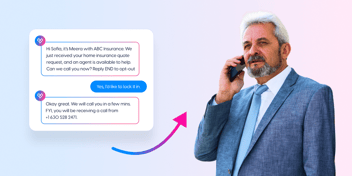
Meera works the other way around. Leads engage over text first (the channel they actually reply to) and the call happens only when the lead is ready to take it. Text gets up to 9x the response rate of calling or emailing alone, which means the lead arrives at the transfer already warm and already qualified.
Here's how that plays out:
- A lead opts in or submits a form.
- Meera engages over SMS within seconds, asks qualifying questions one at a time, and handles objections in natural back-and-forth.
- When the lead signals they're ready to talk, Meera checks your CRM and agent calendars to see who's free.
- Meera dials all available agents at once so the handoff connects on the first try, with full context already passed.
- If no agent is available, Meera keeps the lead warm over text and schedules the call for the soonest workable slot, rather than handing the lead off to a queue or a voicemail.
For inbound calls, Meera's Voice AI handles the same logic from the other direction. The AI answers immediately, qualifies the caller, and live-transfers to an agent at the moment the caller is ready. Whether the lead is reaching you or you're reaching them, the transfer happens when it converts.
The result is a transfer that's genuinely real-time, because the lead is ready before the call ever starts. Routing speed becomes almost beside the point.
See how Meera handles warm call transfer →
AI real-time call transfer in practice
Different verticals hit "peak intent" in different ways. Here's what real-time AI transfer looks like across Meera's core markets.
|
Vertical |
The moment of peak intent |
What the AI transfer does |
|---|---|---|
|
Insurance |
A lead replies to a quote text and is ready to talk |
Qualifies over text, then live-transfers to a licensed agent |
|
Financial services |
A borrower responds to a loan or rate inquiry |
Confirms intent and connects to an available loan officer instantly |
|
Higher ed |
A prospective student engages about enrollment |
Answers questions, then transfers to an admissions advisor |
|
Events / contact center |
An attendee or inbound caller signals buying intent |
Routes to whoever is free, with full context at handoff |
Insurance
A homeowner replies to a quote follow-up at 8:47 PM. Meera handles the back-and-forth, confirms the policy type and ZIP code, and live-transfers to a licensed agent who's still on shift. The agent picks up already knowing the quote and the coverage type. The conversation that follows is a close, not a discovery call.
Financial services
A borrower opts in for a refinance rate quote. Meera engages within 15 seconds, asks two qualifying questions about loan amount and credit profile, and transfers the lead to whichever loan officer has capacity right now. The conversation arrives warm.
Higher ed
A prospective student texts in during open enrollment. Meera answers questions about program length and application deadlines, identifies a serious applicant, and connects them to an admissions advisor while interest is high. The advisor walks into a conversation already in progress, not a cold lead form.
Events and contact center
An inbound caller signals buying intent on a registration line. Meera's Voice AI handles qualification, identifies the right department, and routes to whoever's available, with a summary of what the caller has already said. The same pattern applies across any high-volume inbound contact center where buying intent shows up on a call.
The bottom line
Real-time AI call transfer is a timing problem, not a transfer-volume problem. The win comes from transferring the right calls at the right moment.
For sales teams, the handoff to a human is the moment that pays for everything else. Cold transfers throw that moment away. Warm transfers protect it. Agentic warm transfers, paired with a channel the lead actually replies to, turn it into revenue.
If your team is losing leads to slow callbacks or quiet queues, another dialer probably won't fix it. The real fix is reaching the lead on the channel they'll actually respond to, and being there when they're ready to talk.
FAQ
What is AI real-time call transfer?
AI real-time call transfer is when an AI system connects a live caller to a human agent on the fly, choosing when to transfer based on the conversation, who to transfer to based on agent availability, and what context to pass along. It replaces menu trees and manual transfer steps with an AI that makes those decisions instantly.
What's the difference between AI call transfer and traditional call routing?
Traditional call routing relies on IVR menus or queue-based assignment: the caller picks an option or waits in a queue, then eventually gets connected. AI call transfer skips both. The AI listens, qualifies, identifies the right agent, and connects the call in seconds, with context already passed.
Does AI transfer calls to humans, or replace them?
It transfers them. The AI decides timing and prepares the agent. The human still closes. For sales calls especially, the goal is to make sure the human picks up at the exact moment the lead is ready to have a conversation.
What is an agentic warm transfer?
An agentic warm transfer is when the AI interprets the full conversation, identifies what's actually relevant, and generates an intelligent summary for the receiving agent. The agent picks up genuinely informed, rather than scrolling through a transcript while the lead waits.
Should sales teams try to reduce their call transfer rate?
For support teams, lower transfer rates are generally a positive signal. For sales teams, no. The transfer to a human closer is the conversion event. The right goal is better-timed transfers, not fewer of them. Track whether transfers happen at peak intent, whether the agent picks up, and whether the conversation converts. Transfer count, on its own, is the wrong metric.
How does Meera fit in?
Meera engages leads over text first (the channel they actually reply to) qualifies them in real conversation, and live-transfers to a human agent the moment the lead is ready. For inbound calls, Meera's Voice AI does the same in the other direction. Either way, the transfer happens at peak intent, with full context passed.
About the Author

Grant Weherley